Construction Timelapse Problems: How to Avoid Failure in Long-Term Projects
Construction timelapse can look simple at first glance. A camera is installed, an interval is set, and images begin to accumulate over time.
Part of the series · Long-Term Construction Timelapse GuideConstruction Timelapse for Long-Term Outdoor Projects: The Professional Guide (Months to Years)
Quick answer
Most construction timelapse failures are system problems, not camera problems: power interruptions, connectivity failures, storage issues, weather damage, condensation inside enclosures, mounting drift, and incorrect capture intervals. Because footage of finished construction phases can never be recreated, long-term projects need active monitoring and fast failure detection rather than a one-time installation that is assumed to keep working.
Construction timelapse can look simple at first glance. A camera is installed, an interval is set, and images begin to accumulate over time. But long-term construction timelapse projects are not judged by whether the system works on the first day. They are judged by whether the image stream remains reliable for months or years while the site changes around it.
That is where many projects run into trouble. The most serious construction timelapse problems are rarely caused by the camera alone. In real deployments, failures usually come from the broader system: unstable power, weak connectivity, unmanaged storage, enclosure problems, mounting drift, or the absence of monitoring. For construction companies, project managers, media agencies, and timelapse service providers, the real challenge is not simply capturing images over time. It is maintaining a dependable visual record through changing weather, site activity, restricted access, and operational risk.
In long-term projects, reliability matters more than initial setup convenience. A system that appears to work during installation can still fail weeks later if it was not designed for real construction conditions. That is why the most successful long-term timelapse systems are built around continuity, visibility and fast problem detection rather than hardware alone.
Why long-term timelapse projects often fail
Long-term timelapse projects often fail because they are treated like one-time installations rather than active operational systems. On a construction site, nothing stays static for long. Temporary power sources are reassigned. LTE performance changes. Contractors move equipment. Access becomes restricted. Structures are added that affect signal paths, shadows and camera visibility. Even a well-mounted camera can become vulnerable when the site around it evolves.
Another reason projects fail is that small issues are underestimated. A short network interruption, a slight camera shift, a storage card nearing capacity, or intermittent condensation may not seem serious when viewed individually. But a long-term timelapse is built from thousands of frames captured over many months. Minor interruptions accumulate into visible gaps, unstable framing, missing milestones, and inconsistent sequences. By the time someone notices, the lost material is often impossible to recover.
This is the central difference between short-term photography and long-term construction timelapse. In a short shoot, the operator is usually present and can correct problems immediately. In a multi-month or multi-year deployment, the system must continue working without constant physical supervision. That requires more than a camera. It requires a workflow designed to withstand failure points and expose problems before they become damaging.
The most reliable projects are therefore not the ones with the most expensive camera. For a direct decision between the two most common long-term setup types, read IP Camera vs GoPro for Construction Timelapse. If you are still deciding between setup types, see our guide to the best camera for construction timelapse for a reliability-first comparison of IP camera, GoPro, and DSLR or mirrorless options. For a broader framework on system design, risk management, and reliable long-term outdoor deployment, see our guide to construction timelapse for long-term outdoor projects. They are the ones designed around system resilience. That means assuming from the beginning that power, network, weather and site logistics will create problems, and designing the deployment so those problems can be detected and managed quickly.
The most common problems in construction timelapse
Power interruptions
Power interruptions are among the most common construction timelapse problems because construction sites rarely offer perfectly stable electrical conditions. A camera may be connected to a temporary outlet that later gets repurposed. A breaker may trip when other equipment is added to the same circuit. A cable may be unplugged during nearby work. A distribution box may be moved without anyone realizing the timelapse system depends on it.
When that happens, capture usually stops immediately. But the bigger issue is often what happens after power returns. Some systems do not recover cleanly. A camera may restart but fail to reconnect to the network. A modem may remain offline after a short interruption. A local recording device may not resume properly. In some cases, the system appears to be powered again, but image delivery has silently stopped.
This is why power planning matters so much in long-term construction timelapse reliability. For a deeper look at mains power, battery backup, solar limitations, and recovery planning, read our guide to timelapse camera power supply for long-term construction projects. Stable power is not only about keeping the camera on. It is also about ensuring that the whole chain (camera, modem, router, local controller and upload process) returns to operation automatically after disruption.
Connectivity failures
Connectivity failures are another major source of long term timelapse issues, especially on sites that rely on LTE or temporary network infrastructure. Signal quality can change over time as steel structures, scaffolding, containers, cranes, or newly built walls alter the radio environment. A router can freeze. A SIM card can hit plan limits. Local IT settings can be changed by another contractor. A network that seemed stable during installation may become unreliable later.
The danger with connectivity problems is that they can remain invisible for long periods. The camera may still be taking pictures, but if those images are not reaching the cloud or central archive, the project is effectively blind. If you are still deciding which fixed camera is worth building that workflow around, see our guide to best IP camera construction monitoring for long-term timelapse projects. If you are using a fixed network camera, our guide on how to turn an IP camera into a construction timelapse system explains how snapshot capture, FTP upload, timestamps, and monitoring fit together in practice. Teams often assume that because the camera is still physically mounted, the system is working. In reality, uploads may have stopped days or weeks ago.
This is one of the most costly timelapse camera problems in professional deployments because it creates a false sense of security. If nobody is checking whether current images are still arriving, a major construction phase can pass without usable documentation. By the time someone visits the site, the missing period is gone permanently.
Storage issues
Storage problems are especially common in systems that rely too heavily on local memory cards or unmanaged on-device recording. Over a long timeline, cards fill up, overwrite settings remove older files, file systems become corrupted, or image sequences become fragmented. Teams sometimes assume that large-capacity cards are enough to secure the project, only to discover later that the most important files were overwritten long before retrieval.
Storage problems are not only about available space. They are also about structure and verification. If the workflow depends on occasional manual downloads, there is a high risk of delayed discovery when something goes wrong. If filenames are inconsistent or timestamps are unclear, sorting the sequence later becomes harder. If there is no central archive, even a functioning camera may still produce unreliable project documentation.
For long-term construction timelapse, storage should be treated as an ongoing process, not a passive container. For a deeper look at how that process should work in practice, from FTP upload and timestamp logic to structured archive handling and cloud processing, read our guide to camera FTP upload for long-term projects. Images should be transferred regularly, organized systematically and verified in a central location. Without that, storage remains a hidden point of failure.
Weather and environmental damage
Weather and environmental exposure create a level of stress that many standard camera setups are not prepared to handle over several months or years. Rain, dust, temperature swings, UV exposure, wind, freeze-thaw cycles, vibration, airborne particles and accidental impact all affect performance over time. Hardware that works well in short outdoor use may degrade when deployed continuously on an active construction site.
Real-world failures often begin gradually. A cable gland may loosen. A seal may age under sun exposure. Fine dust may build up on the viewing window. Moisture may enter during maintenance and not be fully sealed out afterward. Heat buildup inside the enclosure may become worse in summer. The result may be subtle image quality decline at first, followed later by major hardware instability or complete failure.
These conditions make long-term construction timelapse reliability a system question rather than a camera question. The issue is not only whether the device is nominally weather resistant. It is whether the enclosure, mounting, cable protection and maintenance approach are all suitable for the full deployment duration. For a focused breakdown of how to build and protect that outdoor setup in practice, read our guide to outdoor timelapse camera installations.
Condensation inside enclosures
Condensation is one of the most underestimated construction timelapse problems in outdoor installations. Even when an enclosure appears weatherproof from the outside, temperature swings can create moisture inside the housing. This is especially common where nights are cool, days are warm, humidity is high, or seasons shift sharply.
The visual effect can be surprisingly severe. Images may look foggy or washed out for hours in the morning. Droplets inside the viewing window can reduce sharpness and contrast. In more persistent cases, moisture contributes to corrosion, unstable electronics, or residue buildup inside the enclosure.
What makes condensation particularly dangerous is that it often goes unnoticed. Teams may inspect the exterior window, see that it looks clean, and assume the image path is clear. Meanwhile, internal fogging is degrading image quality day after day. Over a long project, that can make significant portions of the sequence much less usable, especially during key periods of early morning activity.
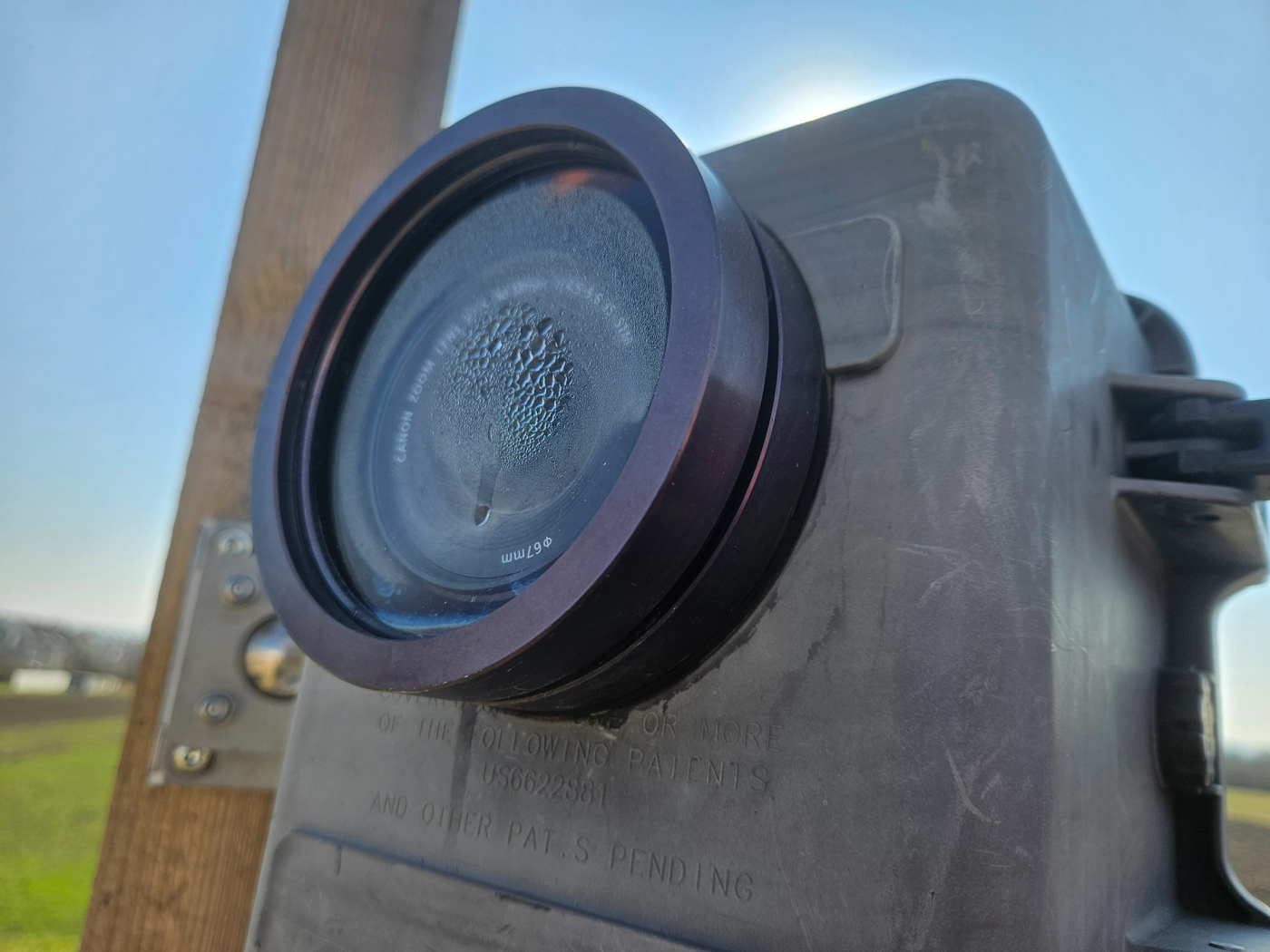
Condensation inside an outdoor timelapse enclosure can reduce image clarity for hours at a time and may remain unnoticed without regular remote image checks.
Camera movement or mounting instability
A construction timelapse depends on stable framing across the life of the project. Even minor movement can become obvious when thousands of images are assembled into a final sequence. Yet construction sites are full of factors that challenge stability: wind load, vibration, structural flex, accidental contact, scaffold changes, and hardware fatigue over time.
A bracket that feels solid during installation may loosen slightly after repeated wind exposure. A pole may flex more than expected. A mounting point may be modified when nearby work progresses. If the camera shifts only a little, the change might not be noticed immediately. But in the finished timelapse, that movement becomes highly visible as a framing jump or unstable horizon.
This is not only a visual problem. It also reduces post-production flexibility. Editors may need to crop more aggressively to stabilize the sequence, which lowers resolution and narrows the field of view. If the shift is large enough, certain project features may move partly out of frame. For clients expecting a clean, professional record of project progress, mounting instability can seriously reduce the value of the final result.
Incorrect capture intervals
Incorrect interval planning is another common source of long term timelapse issues. If the interval is too short, the system may create unnecessary strain on power, storage, upload bandwidth, and processing workflows. If the interval is too long, important activity is underrepresented and the final video may feel sparse or uneven.
This often happens when the interval is chosen without enough consideration for project pace, expected output, and working conditions. A schedule that is acceptable for one phase of construction may be inefficient or insufficient for another. Some systems also run on day-and-night schedules that were never refined, resulting in thousands of dark or low-value images being captured when no meaningful site activity is happening.
There are also configuration mistakes. Daylight changes may not be accounted for. Working hours may be set incorrectly. Timezone issues or clock drift can distort sequence timing. In long-term timelapse, interval design is not a minor technical setting. It directly affects both operational efficiency and the storytelling quality of the final project record.
What happens when these problems go unnoticed
The most damaging scenario in construction timelapse is not that a problem occurs. Problems are expected in long-term outdoor deployments. The real damage happens when those problems go unnoticed. For a deeper look at how remote timelapse monitoring reduces that risk through dashboards, upload checks, and alerts, read our guide to remote timelapse for long-term construction projects.
If power fails and no alert is triggered, the system may stop for days. If uploads fail silently, the archive may go dark without anyone realizing it. If condensation reduces image clarity for weeks, that section of the timeline may become far less useful. If the camera shifts after a storm, the final sequence may be compromised before anyone checks the framing again.
The consequences are rarely limited to technical inconvenience. For the budgeting side of reliability, downtime risk, and full-system planning, see Construction Timelapse Costs: What Companies Should Really Budget For. Missing images can mean missing milestones. A contractor may lose visual documentation of critical project phases. A media agency may have less usable footage for stakeholder communications or marketing. A timelapse service provider may face difficult client conversations, especially if expectations were tied to a clean multi-month record. Editors may spend extra time trying to stabilize or rebuild sequences, often with limited success.
Unlike many other technical issues, missed construction timelapse footage usually cannot be recreated. Once a concrete pour, crane installation, facade phase, or structural transition is over, it is over. That is why unnoticed failure is so costly. It turns a manageable operational issue into irreversible content loss.
Why long-term projects require monitoring, not just setup
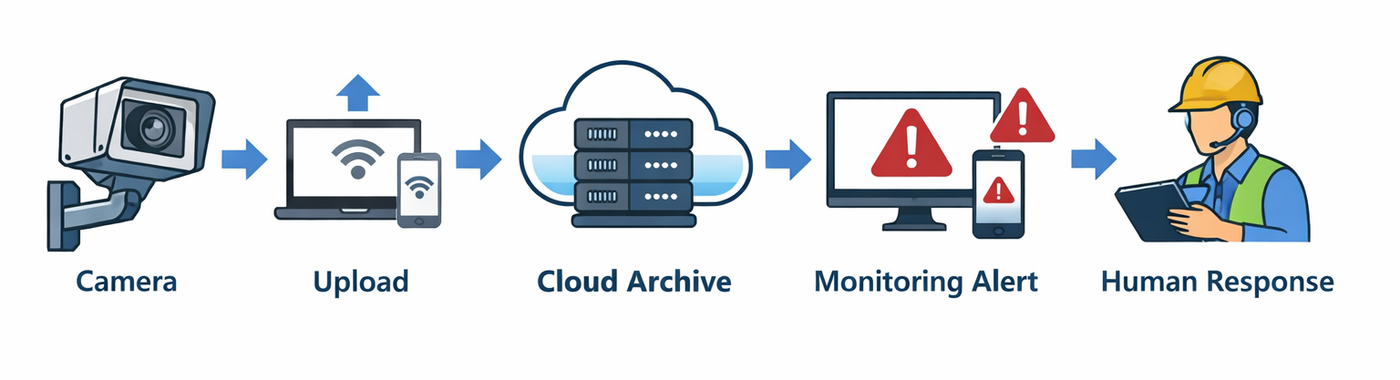
This is why long-term timelapse projects require monitoring rather than just installation. Setup is only the starting point. After deployment, the real question becomes whether the system continues to operate as intended every day, every week, and every month.
Monitoring changes the risk profile of a project because it shortens the time between failure and response. If recent images stop arriving, someone should know quickly. If the upload cadence drops, someone should be alerted. If the latest image looks obscured or the framing has changed, that should be visible before the problem continues for weeks.
Without monitoring, the first sign of trouble often appears far too late. A client requests recent footage. An editor opens the archive. A site visit reveals that the camera has not uploaded in two weeks. At that point, the damage has already happened.
Construction timelapse reliability therefore depends less on whether the system was installed correctly once and more on whether it remains observable throughout the project lifecycle. Monitoring is what turns a passive camera setup into an actively managed visual documentation system.
How professional systems prevent these issues
Professional systems reduce construction timelapse problems by addressing the entire workflow rather than focusing only on image capture. For a practical overview of how capture, upload, storage, monitoring, and rendering should work together, read our guide to the construction monitoring camera timelapse workflow. That typically means stable power architecture, protected outdoor hardware, reliable network design, structured upload processes, centralized archiving, and automated visibility into current system status.
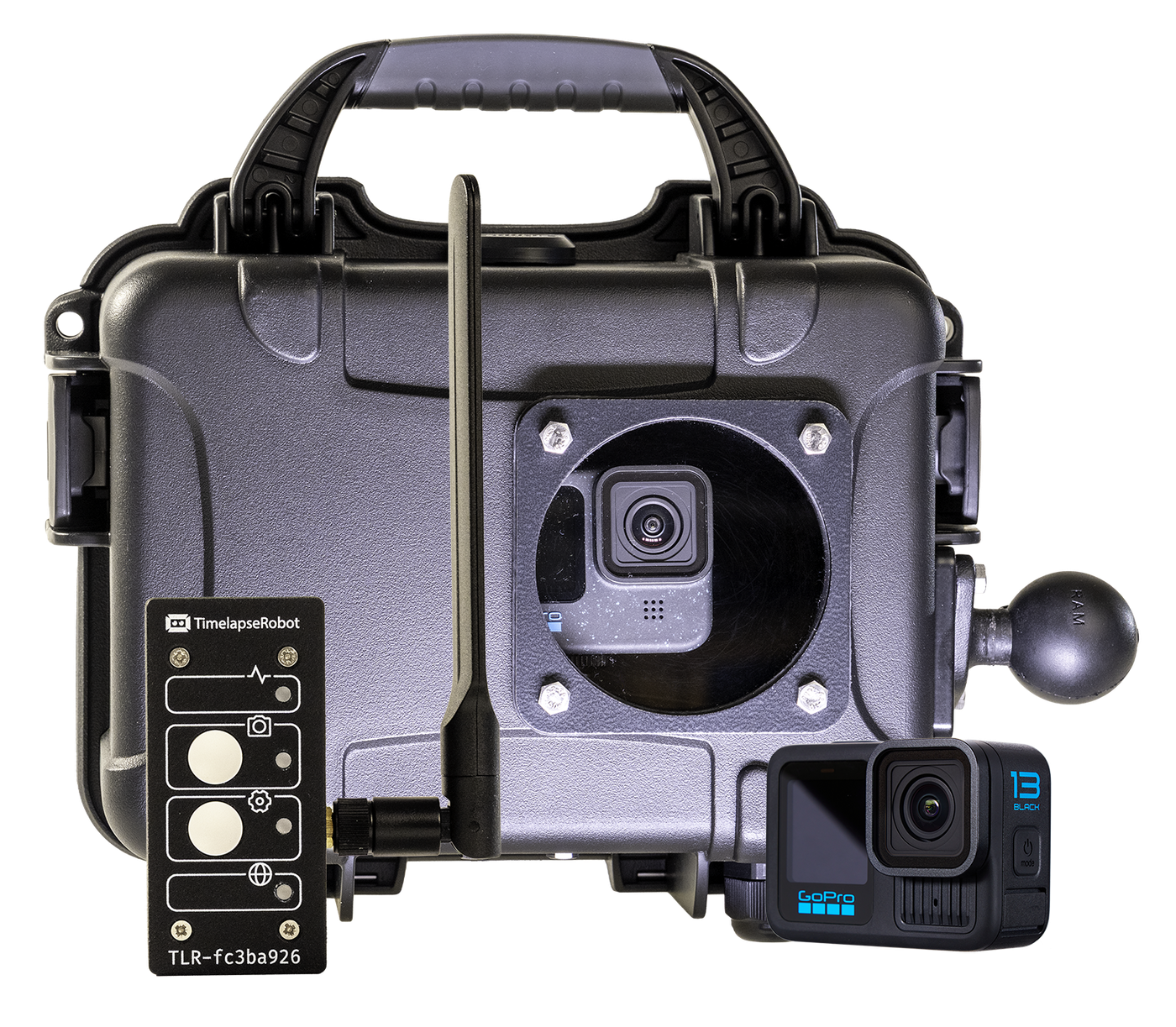
Without remote monitoring, long-term construction timelapse is a gamble.
TimelapseRobot combines a weatherproof GoPro setup with remote connectivity and cloud storage allowing you to monitor your project from anywhere.
• Remote health monitoring
• Automatic cloud upload
• Weatherproof GoPro housing
Explore the Construction Timelapse System
The principle is simple: assume that something will eventually go wrong and design the system so it is easy to detect and recover from. That might include restart behavior testing after power interruptions, remote image verification, alerting when uploads stop, storage validation, or regular checks of framing consistency and image quality.
Professional systems also reduce dependence on memory and manual luck. Instead of assuming that someone will remember to check the camera, they make current system health visible. Instead of relying on periodic manual retrieval, they move images into an organized, accessible archive. Instead of hoping that enclosure performance remains acceptable across seasons, they account for environmental stress as part of the design.
This is the practical foundation of construction timelapse reliability. It is not based on optimism. It is based on controlled visibility and system discipline.
Best practices to ensure reliable multi-month operation
Reliable multi-month timelapse begins with realistic site assessment. Before installation, the project team should evaluate available power, likely construction changes, signal quality, maintenance access, weather exposure and safe mounting options. The best camera angle is not always the best operational position if that viewpoint becomes inaccessible or unstable later.
Power design should be treated as critical infrastructure. The system should be connected in a way that minimizes accidental interruption and recovery behavior should be tested instead of assumed. A camera that powers back on is not enough if the network or upload process does not recover with it.
Connectivity should be verified under real site conditions, not only during a short installation window. If LTE is used, signal strength, bandwidth behavior, and ongoing connectivity visibility matter. The goal is not only connection at installation, but dependable image delivery throughout the project.
Storage should be designed as an archive workflow. Images should be transferred regularly, timestamped clearly, and organized consistently in a central location. Local storage may still play a role, but it should not be the only protection against loss.
Outdoor protection deserves as much planning as image quality. If you are planning a GoPro-based deployment, our GoPro construction timelapse setup guide covers long-term power, weather protection, and monitoring in more detail. Enclosures, seals, cable entries, and lens windows should be chosen for long-duration exposure. Internal condensation risk should be considered from the start, not only after the first fogged images appear. Seasonal change is part of the design problem.
Mounting should be engineered for stability over time. The camera should be attached to a structure that can remain rigid through wind, vibration, and site changes. Alignment should be checked not just once, but repeatedly during the project, especially after storms or nearby structural work.
Capture intervals should be based on project needs rather than default settings. The interval should reflect the pace of visible change, the intended output and the operational limits of the system. What matters is not maximum image volume, but consistent, useful documentation.
Finally, responsibility should be explicit. Someone must own monitoring, alert review and response coordination. Many long-term construction timelapse issues persist not because they are technically difficult, but because nobody is clearly responsible for acting when signs of failure appear.
Conclusion
The central lesson of long-term construction timelapse is straightforward: the biggest problems are usually not camera problems. They are system problems.
Power interruptions, connectivity failures, storage issues, environmental damage, condensation, mounting drift and incorrect capture intervals are all common in real deployments. None of them are unusual. What separates successful projects from failed ones is whether the system is designed to withstand them, detect them, and recover from them quickly.
For construction companies, project managers, agencies, and timelapse service providers, that means reliability should be treated as the primary requirement from the beginning. A long-term timelapse is not simply a camera attached to a jobsite. It is an ongoing documentation system operating in a changing environment.
The more complex and longer the project, the more that success depends on monitoring, structured workflows and careful system design. In the end, the most valuable construction timelapse systems are not the ones that look good on installation day. They are the ones that still deliver a consistent, usable image record after months or years in the field.
Frequently asked questions
- What are the most common reasons a construction timelapse fails?
- The most frequent failure points are power interruptions, connectivity failures, storage problems from unmanaged memory cards, weather and environmental damage, condensation inside the enclosure, camera movement from unstable mounting, and incorrectly planned capture intervals. These are system issues rather than camera defects, which is why projects treated as one-time installations fail more often than those run as actively monitored operational systems.
- How can I tell if my timelapse camera has stopped uploading images?
- Often you cannot tell from the site itself: the camera may still be mounted and even capturing while uploads have silently stopped for days or weeks because of a frozen router, SIM plan limits, or changed network settings. Reliable detection requires monitoring whether current images are actually arriving, with alerts when the upload cadence drops. Without that, the first sign is usually a client requesting footage that no longer exists.
- Why do my construction camera images look foggy in the morning?
- Morning fogging is usually condensation inside the enclosure. Temperature swings between cool nights and warm days create moisture on the inside of the viewing window, making images look foggy or washed out for hours and reducing sharpness and contrast. It often goes unnoticed because the exterior window looks clean, and over time persistent moisture can also contribute to corrosion and unstable electronics.
- Can missing timelapse footage be recovered or recreated later?
- No. Unlike many technical issues, missed construction timelapse footage usually cannot be recreated. Once a concrete pour, crane installation, façade phase, or structural transition is over, it is over. That is why unnoticed failure is so costly: it turns a manageable operational issue into irreversible content loss, missing milestones, and difficult client conversations.
- Is a large memory card enough to protect a long-term image archive?
- No. Over a long timeline, cards fill up, overwrite settings delete older files, file systems become corrupted, and sequences fragment. Teams sometimes assume high-capacity cards secure the project, only to find the most important files were overwritten long before retrieval. Storage should be an ongoing process: images transferred regularly, timestamped clearly, and verified in a central archive, with local storage as backup rather than the only protection.
- Does a timelapse system recover on its own after a power outage?
- Not always, and this is where much of the damage happens. A camera may restart but fail to reconnect to the network, a modem may stay offline after a short interruption, or a local recorder may not resume properly. The system can appear powered while image delivery has silently stopped. Recovery behavior of the whole chain, from camera to modem to upload process, should be tested rather than assumed.
Planning a long-term construction timelapse?
Discover the system built for multi-month and multi-year construction deployments.
Explore the Construction Timelapse System

