Timelapse Camera Power Supply for Long-Term Construction Projects
For any long-term construction or outdoor documentation project, the timelapse camera power supply is the foundation of system reliability.
Part of the series · Long-Term Construction Timelapse GuideConstruction Timelapse for Long-Term Outdoor Projects: The Professional Guide (Months to Years)
Quick answer
Continuous mains power, protected with surge protection and a short-term UPS or battery buffer, is the most reliable power supply for a long-term construction timelapse camera. Battery-only setups suit temporary phases, and solar only works with strong sun exposure and worst-case sizing. Remote monitoring is essential, because power failures usually happen quietly and go unnoticed for days.
For any long-term construction or outdoor documentation project, the timelapse camera power supply is the foundation of system reliability. Cameras, enclosures, mounts and software all matter, but none of them can compensate for an unstable power design. If power fails during a critical construction phase, the most valuable footage is often lost permanently.
This is why power planning in professional timelapse deployments must be approached as an operational issue, not just a hardware detail. A camera system that is expected to run for several months or years must remain stable through weather changes, shifting site conditions, temporary power interruptions, maintenance access restrictions and the realities of live construction environments. In that context, reliability, monitoring, and recoverability matter more than theoretical autonomy figures. For a broader view of how remote timelapse monitoring turns system visibility into faster response, read our guide to remote timelapse for long-term construction projects.
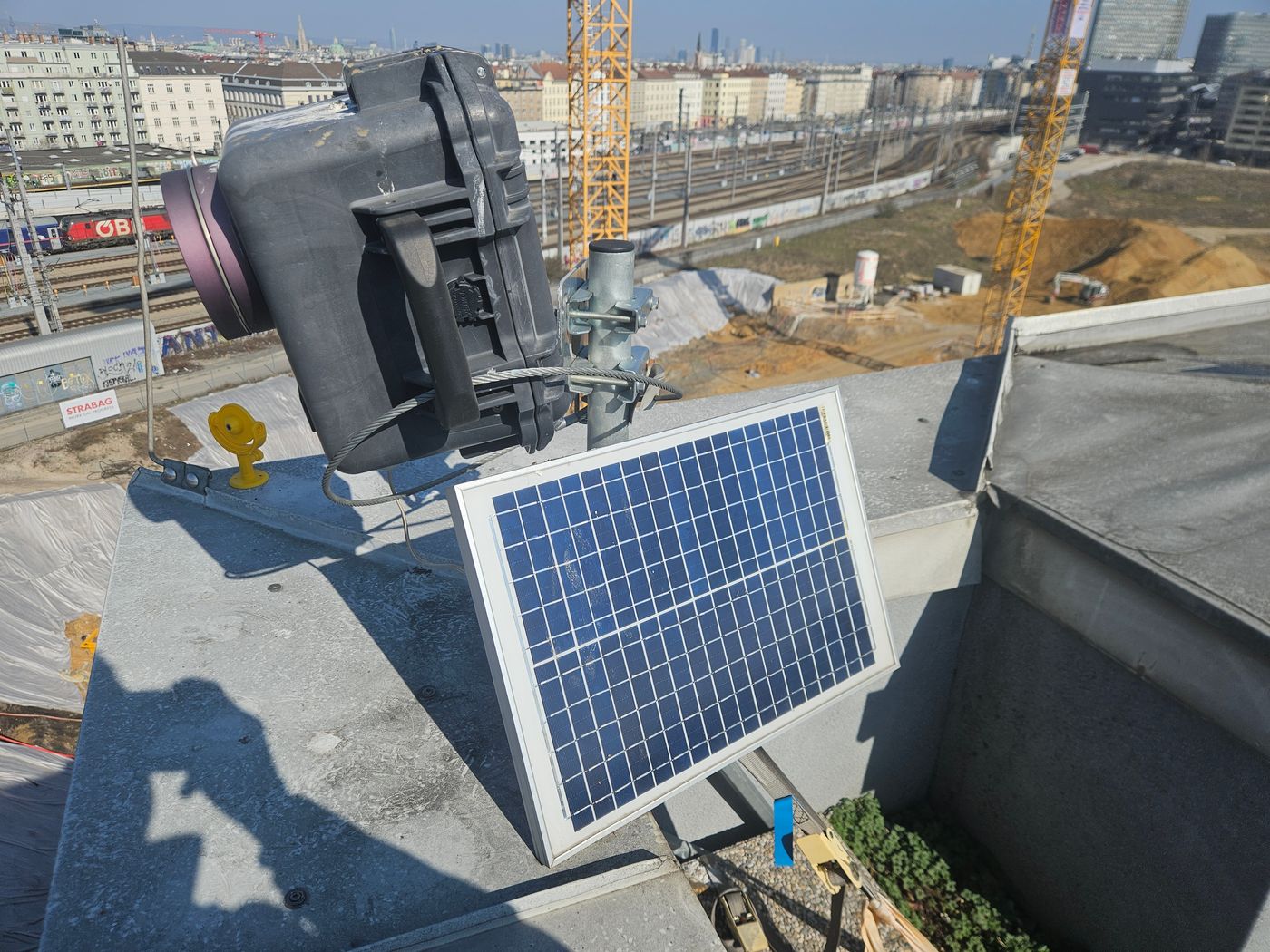
Why Timelapse Camera Power Supply Is the Most Critical Factor in Long-Term Construction Timelapse
For the broader system-level framework behind reliable capture, read our guide to construction timelapse for long-term outdoor projects.
If you are still deciding which hardware category fits your project best, read our guide to the best camera for construction timelapse. If your shortlist is specifically between fixed IP cameras and GoPro-based systems, see our practical long-term comparison for construction timelapse.
In long-term construction timelapse, failure usually does not happen in a dramatic way. More often, it happens quietly. A breaker trips. A cable is unplugged. A battery begins to degrade. A solar panel output drops below expectations. A modem continues to draw power, but the camera stops uploading. Days may pass before anyone notices.
That is what makes power reliability so important. Long-term timelapse projects are not judged by how well the system worked on average. They are judged by whether the visual record is complete. Missing a high-value moment such as steel erection, a major concrete pour, façade installation, crane assembly, or final handover preparations can reduce the value of the entire sequence.
Professional buyers are not just investing in a camera. They are investing in continuity. A system that produces beautiful images for most of the project but fails during critical milestones is not a successful system. For construction companies, developers, and agencies, that failure can affect internal reporting, stakeholder communication, marketing output and final project documentation.
This is why the best long-term timelapse power strategy is usually the one that reduces uncertainty the most. Reliable power supports stable image capture, consistent uploads, dependable remote access, and early fault detection. Power is only one part of the larger construction timelapse workflow, which also includes upload, storage, monitoring, and rendering. Without it, every other feature becomes less important.
Without remote monitoring, long-term construction timelapse is a gamble.
TimelapseRobot combines a weatherproof GoPro setup with remote connectivity and cloud storage allowing you to monitor your project from anywhere.
• Remote health monitoring
• Automatic cloud upload
• Weatherproof GoPro housing
Explore the Construction Timelapse System
Typical Power Requirements of a Timelapse Camera System Over Multi-Month Periods
When people estimate power needs, they often focus only on the camera itself. In a professional deployment, that is rarely enough. A long-term construction timelapse system usually includes several power-consuming components beyond the camera body.
The full system may include the camera, a controller or interval management device, a cellular router or modem, local storage, remote monitoring hardware, and sometimes heating, ventilation, or power conditioning inside the enclosure. Even when each component appears efficient individually, the combined load over months becomes significant.
Another important point is that power demand is not static. Some components have low average draw but higher peak consumption. Connectivity hardware may use more power during transmission bursts. Remote monitoring devices may require constant background operation. Environmental protection systems may activate more frequently in cold or humid conditions. All of this affects how the system should be designed.
For long-term operation, the goal is not to calculate the minimum theoretical energy requirement. The goal is to design for real-world behavior with enough reserve to handle variability. That means accounting for continuous draw, peak draw, conversion losses, cable losses, and future changes in system requirements.
This is especially relevant in professional construction projects, where the system often needs to deliver more than just interval images. Clients may expect image previews, health reporting, remote diagnostics, and immediate visibility into whether the camera is still working. Those features are extremely valuable, but they also increase overall energy demand. A realistic construction timelapse power plan must include them from the beginning.
If you plan to use a GoPro as the capture device, see our GoPro construction timelapse setup guide for the practical system design behind long-term monitored deployments.
Continuous Mains Power as the Preferred Solution in Professional Deployments
In most professional long-term deployments, continuous mains power is the preferred solution. It offers the highest level of operational stability, the lowest maintenance burden, and the best platform for remote monitoring and controlled recovery.
Where stable site power is available, it usually provides the strongest basis for reliable capture over several months or years. This is true because mains power removes the daily uncertainty associated with battery depletion and solar charging variability. It allows the system to operate continuously without depending on weather patterns, charging cycles, or frequent service visits.
Mains power also supports a more robust system architecture. If the project later requires more frequent uploads, additional health checks, upgraded networking equipment, or changes to the capture workflow, a mains-powered setup is more likely to accommodate those needs without redesigning the entire power concept.
In professional deployments, mains power should not mean simply plugging the system into the nearest socket and hoping for the best. It should include proper power conversion, surge protection, cable protection, weatherproof integration and a considered restart strategy after interruptions. On construction sites, temporary power infrastructure is often imperfect. Even when mains is available, it still needs to be treated as part of a controlled system design.
The best results usually come from combining mains power with a short-term backup layer such as a UPS or protected battery buffer. This helps bridge small interruptions and prevents unstable restarts. A professional system should not only stay powered under normal conditions. It should also fail gracefully and recover predictably when the site power environment becomes unstable.
Battery-Only Setups and Their Limitations in Long-Term Environments
Battery-only setups may appear attractive because they are simple to deploy and do not require access to site infrastructure. In some cases, they can be useful for temporary installations or early project phases before permanent power becomes available. For multi-month or multi-year construction timelapse, however, they are usually a weak primary strategy.
The first limitation is obvious: batteries have finite capacity. That means the system will always depend on charging, swapping, or regular field maintenance. Each of those service events introduces risk. If access is restricted, if the site contact is unavailable, or if maintenance is delayed during a critical period, the system may go offline.
The second limitation is that batteries rarely perform the same way in real outdoor conditions as they do on paper. Temperature has a major influence. Cold weather can reduce effective capacity. Heat can accelerate degradation. Because power reliability is closely tied to enclosure temperature, seasonal exposure, and overall outdoor hardening, see our guide to outdoor timelapse camera setups. Repeated cycling reduces long-term performance. Over time, the battery that once seemed comfortably sized may become marginal.
This becomes even more problematic when remote monitoring and connectivity are required. A battery-only system with a camera and modem may have far shorter real runtime than expected, especially if transmission frequency increases or site conditions force higher background activity. In theory, the setup may appear autonomous for a long time. In practice, the safe maintenance interval may be much shorter.
For that reason, battery-only systems should usually be seen as temporary solutions, bridging solutions, or backup layers rather than the main timelapse camera power supply for a long-term construction deployment.
Solar Power for Construction Timelapse: When It Works, and Where It Often Fails
Solar power has a clear appeal in outdoor documentation. It promises independence from site infrastructure and can make remote installations possible where mains power is not available. In some cases, it is the only practical option. But in professional construction timelapse, solar needs to be evaluated with realism rather than optimism.
Solar power can work well when the site has strong sun exposure, stable environmental conditions, limited shading, appropriately sized battery storage and a conservative monitoring strategy. The problem is that active construction sites rarely remain that stable for long.
Seasonal Limitations
The largest structural weakness of solar in long-term deployments is seasonality. A system that performs well in spring or summer may struggle significantly in autumn and winter. Shorter days, lower sun angles, more persistent cloud cover and snow or moisture on panels all reduce energy production.
For construction timelapse projects that span multiple seasons, this is not a minor detail. It is a core design constraint. Systems must be sized for worst-case periods, not best-case months. If a solar system is only comfortable during favorable weather, it is not truly reliable for long-term professional use.
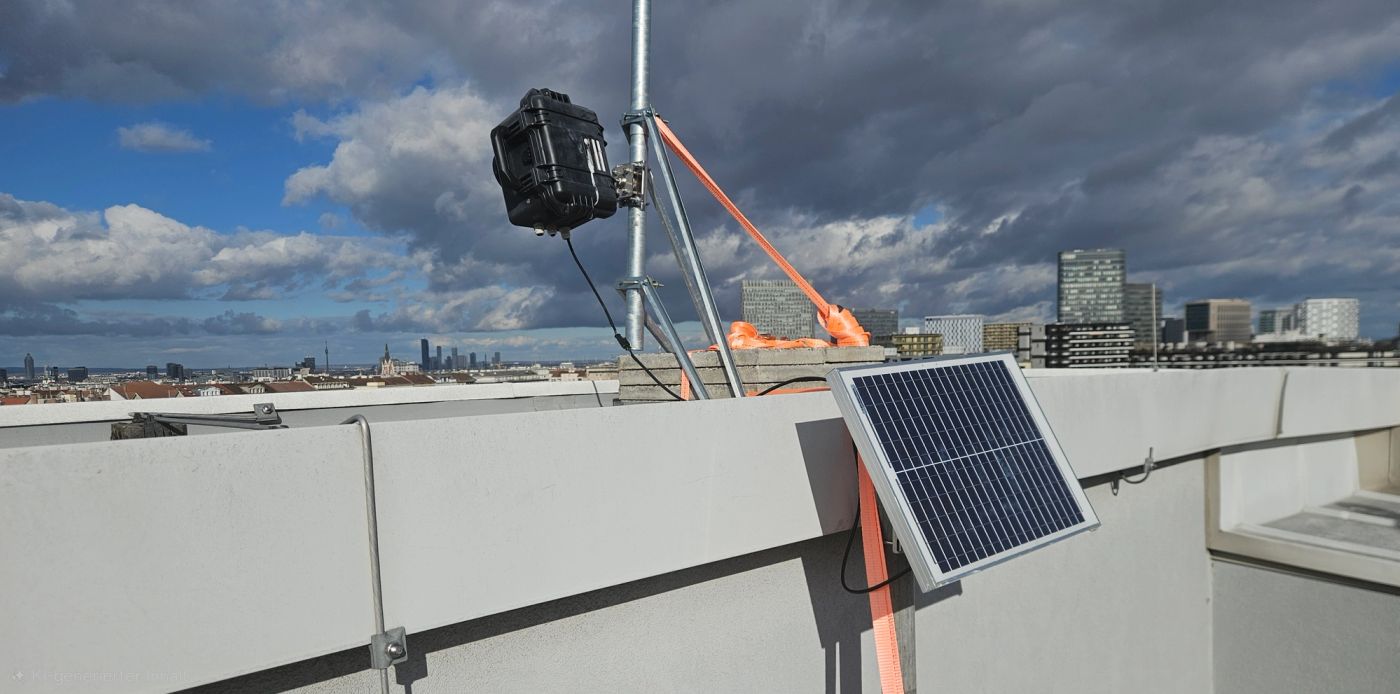
Dust and Shading on Construction Sites
Construction sites are dynamic and often hostile to solar performance. Dust, dirt, and airborne debris can accumulate on panels and reduce output. Temporary scaffolding, stored materials, cranes, new structures, and moving equipment can create unexpected shading over time. A panel location that appears ideal during installation may become compromised weeks later as the site evolves.
This is one of the main differences between solar in a controlled off-grid environment and solar on an active construction project. On a live site, the energy profile may change without warning. That makes long-term planning more difficult and increases the importance of monitoring.
Battery Degradation
Solar systems are not just about panels. They depend heavily on energy storage. The battery in a solar-powered system is often the most stressed component because it cycles continuously. Over time, battery capacity declines and that decline reduces resilience during low-generation periods.
This means a solar system can become less reliable month by month even if the panel itself remains physically intact. Many underperforming solar deployments are not caused by a dramatic single failure. They are caused by gradual loss of storage performance combined with seasonal changes and rising site complexity.
Monitoring Challenges
Solar systems require better monitoring than many teams initially expect. It is not enough to confirm that images are still arriving. Operators need visibility into battery state, charging trends, voltage behavior, and early warning signs of decline.
Without this visibility, failures often develop gradually and go unnoticed until meaningful capture gaps have already occurred. In professional long-term timelapse, that lack of diagnostic clarity is one of the main reasons solar should be approached cautiously. It can be a valid solution where no site power exists, but it should not automatically be treated as the preferred option.
For most professional construction projects, solar is best understood as a constrained solution for specific site conditions, not a universal answer for outdoor timelapse power supply.
Power Consumption Considerations: Camera, Connectivity and Remote Monitoring
A professional long-term timelapse system should be sized around the total operational requirement, not just image capture. That includes the camera, the connectivity hardware, the control electronics and the monitoring layer.
The same principle applies to an IP camera construction timelapse workflow, where FTP upload, connectivity, and remote monitoring all depend on reliable power. If you are also evaluating which fixed camera fits that workflow best, see our guide to best IP camera construction monitoring for long-term timelapse projects. For a closer look at the upload side of that workflow, including how FTP delivery, timestamps, archive structure, and cloud processing fit together, read our guide to camera FTP upload for long-term projects.
Connectivity is especially important. Many long-term failures become expensive because teams do not know there is a problem until much later. A connected system with proper monitoring can alert operators when uploads stop, when power drops, or when system behavior changes. That visibility is worth the extra energy cost.
The same is true for remote diagnostics. In commercial projects, the ability to check the recent image history, confirm last contact and assess device health remotely can save site visits and shorten recovery time. These features consume power, but they also reduce downtime risk.
This is the right way to evaluate long-term timelapse power: not by asking how little the system can consume, but by asking what power level is needed to support dependable operation. A system that is highly efficient but difficult to monitor may be less reliable overall than one that uses more power but provides far better visibility and control.
Backup Strategies and Redundancy in Professional Systems
In professional deployments, the strongest power design is usually not a single power source with a large theoretical margin. It is a layered system with sensible backup strategies.
For mains-powered installations, a UPS or managed backup battery can protect against short interruptions and allow the system to continue operating or shut down cleanly. This is especially valuable on construction sites where temporary power instability is common.
Redundancy also matters at the system behavior level. Devices should restart automatically after a brief outage. Routers should reconnect without manual intervention. Cameras should resume normal capture schedules. Local and remote components should be designed to recover predictably instead of requiring a technician to physically reset the system.
Monitoring redundancy can also be valuable. A power design is stronger when loss of primary capture does not immediately eliminate all visibility. The most dependable professional systems separate fault detection from the main capture path as much as practical, so operators still receive alerts when something begins to fail.
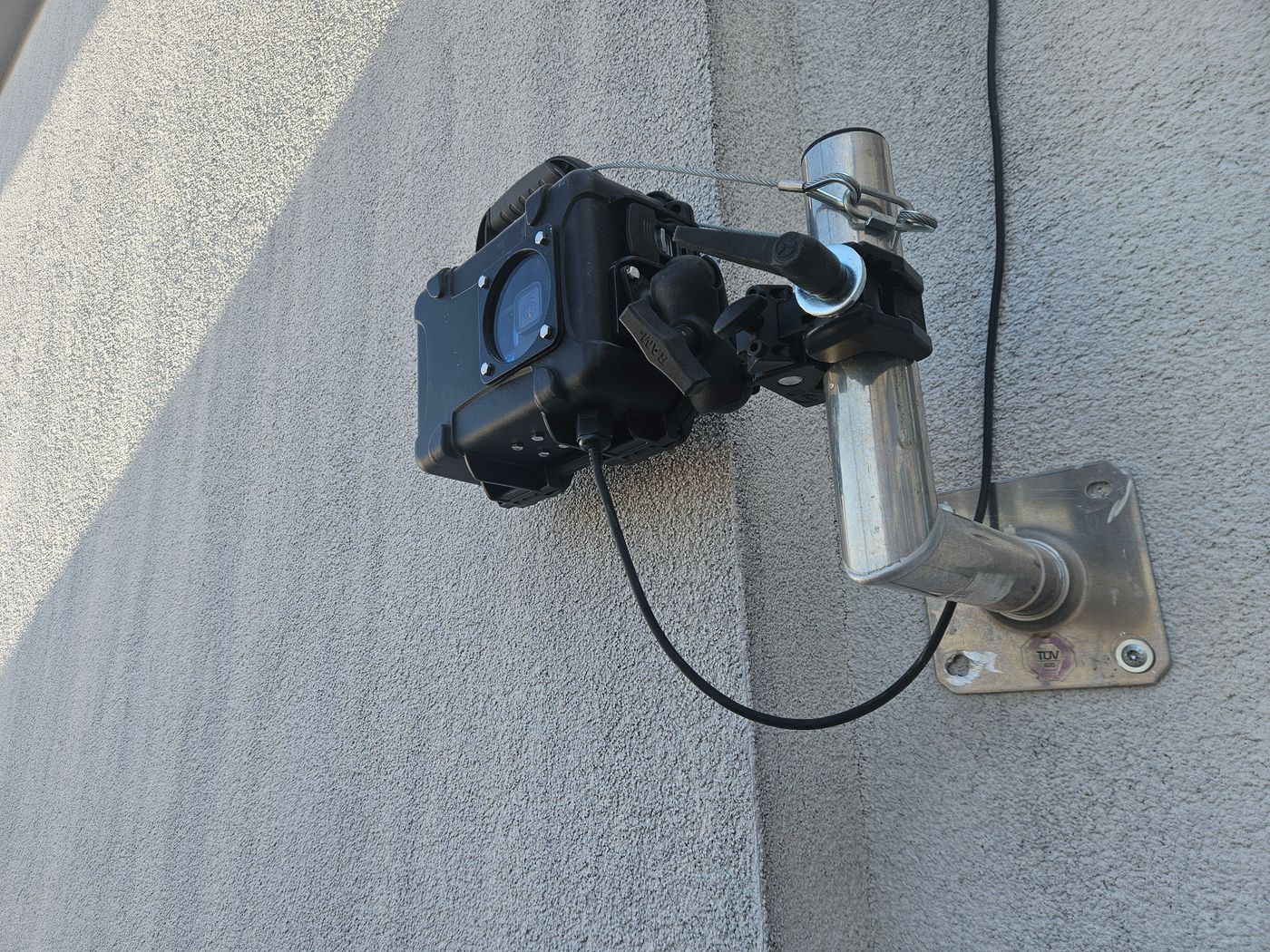
A TimelapseRobot camera connected to continuous mains power
Common Power-Related Failure Scenarios in Real Construction Projects
The most common power-related failures are not exotic. For the broader picture beyond power alone, including connectivity, storage, condensation, and mounting issues, read Construction Timelapse Problems: How to Avoid Failure in Long-Term Projects. They are ordinary site events.
A power cable is disconnected during nearby work. A temporary socket is reassigned. A breaker trips because additional site equipment is added to the same circuit. If you want to see how power design and monitoring choices affect the total budget, read our guide to construction timelapse costs and what companies should really budget for. A weatherproof connection is not resealed properly after maintenance. A solar panel becomes partially shaded by a newly erected structure. A battery that was adequate in summer becomes insufficient in winter. A short power interruption causes the modem to remain offline even though the camera restarts.
These are exactly the kinds of failures that long-term systems must be built to handle. The question is not whether the site will change. It will. The question is whether the power design, monitoring layer, and recovery strategy are strong enough to prevent those changes from becoming major capture gaps.
Best Practices to Ensure Uninterrupted Operation During Critical Construction Phases
The best practice is to choose the most stable primary power source available and then strengthen it with monitoring and backup. In most professional cases, that means mains power first, protected properly, with a short-term backup layer and reliable remote monitoring.
Power ownership should be defined clearly. Someone on the site must know that the camera system depends on a specific supply and that supply should not be treated as disposable temporary convenience power. Routing, labeling, and protection all matter.
Monitoring should increase around milestone phases. Before major pours, steel work, façade installation, or public-facing project events, the system should be checked proactively. Last image time, power status, connectivity health, and recent behavior should all be reviewed before the event begins.
Above all, system design should be conservative. Long-term construction timelapse is not the place to optimize for theoretical autonomy while accepting operational uncertainty. The most successful projects are built around continuity, visibility, and controlled recovery.
For that reason, the right timelapse camera power supply is usually not the most independent-looking solution on paper. It is the one most likely to stay online, remain observable and recover cleanly under real site conditions over months or years. In long-term construction timelapse, that is what delivers the footage that clients actually need.
Frequently asked questions
- What is the best power supply for a long-term construction timelapse camera?
- Where stable site power is available, continuous mains power is the preferred solution in professional deployments. It removes the daily uncertainty of battery depletion and solar variability and offers the lowest maintenance burden. It should include proper power conversion, surge protection, cable protection, weatherproof integration and a considered restart strategy, ideally combined with a short-term backup layer such as a UPS to bridge small interruptions.
- Can I run a construction timelapse camera on batteries alone?
- For multi-month or multi-year projects, battery-only setups are usually a weak primary strategy. Batteries have finite capacity, so the system always depends on charging, swapping or field maintenance, and each service event introduces risk. Cold reduces effective capacity, heat accelerates degradation, and adding a modem for monitoring shortens real runtime further. Battery-only systems are best treated as temporary, bridging or backup solutions.
- Does solar power work for a construction timelapse camera?
- Solar can work with strong sun exposure, limited shading, appropriately sized battery storage and conservative monitoring, and it may be the only option where no mains power exists. On active construction sites it often fails, though: shorter winter days reduce production, dust settles on panels, and new structures, scaffolding or cranes create unexpected shading. Systems must be sized for worst-case periods, not best-case months.
- How much power does a timelapse system need beyond the camera itself?
- A long-term system typically also powers a controller or interval management device, a cellular router or modem, local storage, remote monitoring hardware and sometimes heating or ventilation inside the enclosure. Demand is not static: connectivity hardware peaks during transmission bursts and environmental protection activates more in cold or humid conditions. Design for real-world behavior with reserve, including peak draw, conversion losses and cable losses.
- What are the most common power failures on construction sites?
- They are ordinary site events rather than exotic faults: a cable disconnected during nearby work, a temporary socket reassigned, a breaker tripping when more equipment joins the circuit, a weatherproof connection not resealed after maintenance, a solar panel shaded by a new structure, a battery that was adequate in summer failing in winter, or a modem staying offline after a short outage even though the camera restarts.
- How do I make sure the camera keeps recording during critical construction phases?
- Define clear power ownership so the site team knows the camera depends on a specific, protected supply. Increase monitoring before milestones such as major pours, steel work or facade installation: check last image time, power status and connectivity health proactively. Design conservatively, with devices that restart automatically and routers that reconnect without manual intervention, because missed milestone footage cannot be recreated afterwards.
Planning a long-term construction timelapse?
Discover the system built for multi-month and multi-year construction deployments.
Explore the Construction Timelapse System

