Remote Timelapse Monitoring for Long-Term Construction Projects
Remote timelapse helps construction teams detect failures early, reduce site visits, and manage long-term camera deployments more reliably.
Part of the series · Long-Term Construction Timelapse GuideConstruction Timelapse for Long-Term Outdoor Projects: The Professional Guide (Months to Years)
Quick answer
Remote timelapse means running a camera you can monitor, verify and manage from anywhere — not just one that records. A reliable setup needs four things: a mobile or WiFi connection, automatic cloud image storage, an ingestion workflow that timestamps every photo, and a dashboard with health and upload alerts. The payoff is fewer site visits, faster problem detection and footage you can trust across a multi-month project.
In long-term visual documentation, the real challenge is rarely taking the first image. The real challenge is keeping the system visible, verifiable and manageable over the full life of the project.
That distinction matters in construction, project development and professional media production. A camera can be installed correctly, framed well and technically capable of producing strong images, yet the overall deployment can still become difficult to operate once the project enters its normal rhythm. Months pass. Site conditions evolve. Access changes. Teams rotate. Expectations remain high. The question is no longer whether the camera can capture an image, but whether the timelapse workflow can be supervised reliably from a distance.
This is where remote timelapse becomes important. In a professional context, remote capability is not simply a convenience feature. It is the operating layer that allows long-term documentation systems to be run with consistency, oversight and accountability. For companies managing projects across extended timeframes, remote timelapse monitoring turns a camera installation into a maintainable process.
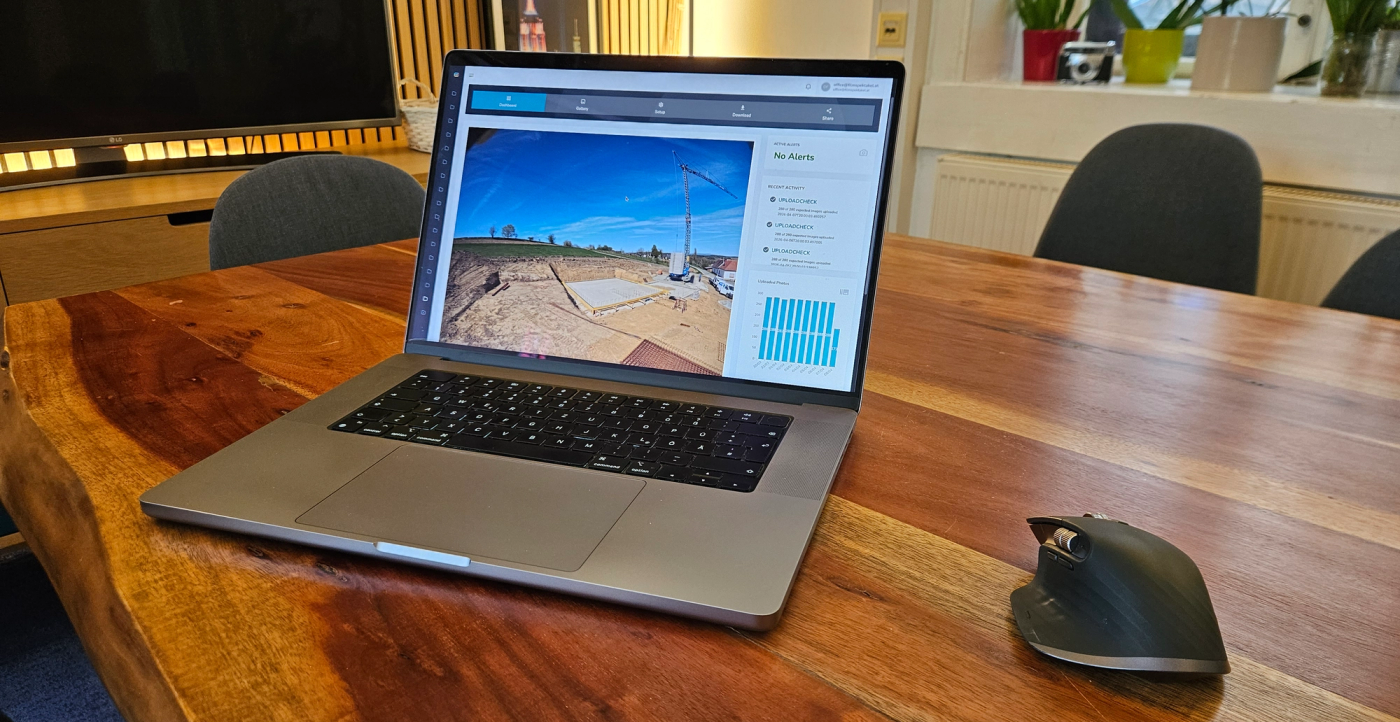
Why do traditional timelapse setups fail in long-term projects?
Many traditional timelapse setups are designed around installation rather than operation. For a broader look at system design, environmental risk, and operational discipline in long-term outdoor deployments, see our long-term outdoor construction timelapse guide.They focus on camera choice, mounting, interval settings and storage at the moment of deployment, but give much less attention to how the system will be supervised over the following months or years. If a fixed network camera is part of your shortlist, see our guide to best IP camera construction monitoring for long-term timelapse projects.
That gap is manageable in short productions. It becomes a serious weakness in long-term environments. A system may appear complete on day one, yet offer almost no practical visibility afterward. The team knows where the camera is mounted, but not whether images are still arriving on schedule. They know the settings were configured, but not whether those settings are still being executed. They know the device is physically present, but not whether it is still contributing usable documentation.
In many conventional workflows, the only real check is a site visit or a manual review of locally stored material. That means operational awareness is delayed by design. Instead of supervising the system continuously, teams discover the condition of the deployment only when they physically return to it or retrieve files later.
For long-duration projects, that approach is too passive. Construction timelapse is not simply about capture. It is about continuity. If continuity cannot be observed remotely, it cannot be managed with confidence.
What does “remote timelapse” actually mean?
The term remote timelapse should be understood as more than remote viewing. A professional system is not defined by whether someone can log in and look at a camera feed. If you are comparing the two most common connected approaches, see our IP camera vs GoPro timelapse comparison. It is defined by whether the documentation workflow can be monitored and managed off-site over time.
In practice, that means several things happening together. The system must be able to move image data away from the camera environment on a regular basis. It must make recent activity visible through central infrastructure. It must allow operators to confirm that expected image intervals are still being produced. It should provide a way to review the latest received material, not only for proof of life, but also for framing, scene clarity and general project relevance.
This is why remote timelapse monitoring is better understood as an operational framework rather than a single feature. It combines image delivery, status visibility, workflow control and response capability. In other words, it supports not just capture, but supervision.
For professional users, that shift is important. A camera that runs locally may still create images. A remotely managed system creates confidence.
The biggest risks of not having remote access
The main risk of operating without remote access is not that something might go wrong. The main risk is that the organization does not know what is happening until much later.
Power interruptions, storage limitations, configuration issues and device instability are all possible in long-term deployments. For a deeper look at stable mains power, backup layers, and recovery after interruptions, read our guide to timelapse camera power supply for long-term construction projects. But the operational problem is not only the event itself. It is the absence of immediate visibility around the event. Without remote oversight, the team cannot easily distinguish between an active system, a partially degraded system and a non-functioning one.
That uncertainty creates avoidable exposure. A camera may stop uploading while still appearing physically intact. A local capture process may stall while the installation still looks powered on. Files may still exist, but no longer arrive centrally in the expected sequence. When none of these conditions are visible remotely, documentation continuity becomes an assumption rather than a managed outcome.
For construction timelapse monitoring, this matters because long-term projects do not pause while the documentation system becomes uncertain. Site progress continues. Structural changes continue. Milestones continue. If the visual record is interrupted and the interruption is discovered late, the lost period usually cannot be reconstructed.
Remote access reduces that uncertainty. It does not eliminate every risk, but it makes the state of the system observable. That is the real advantage.
Key components of a remote timelapse system
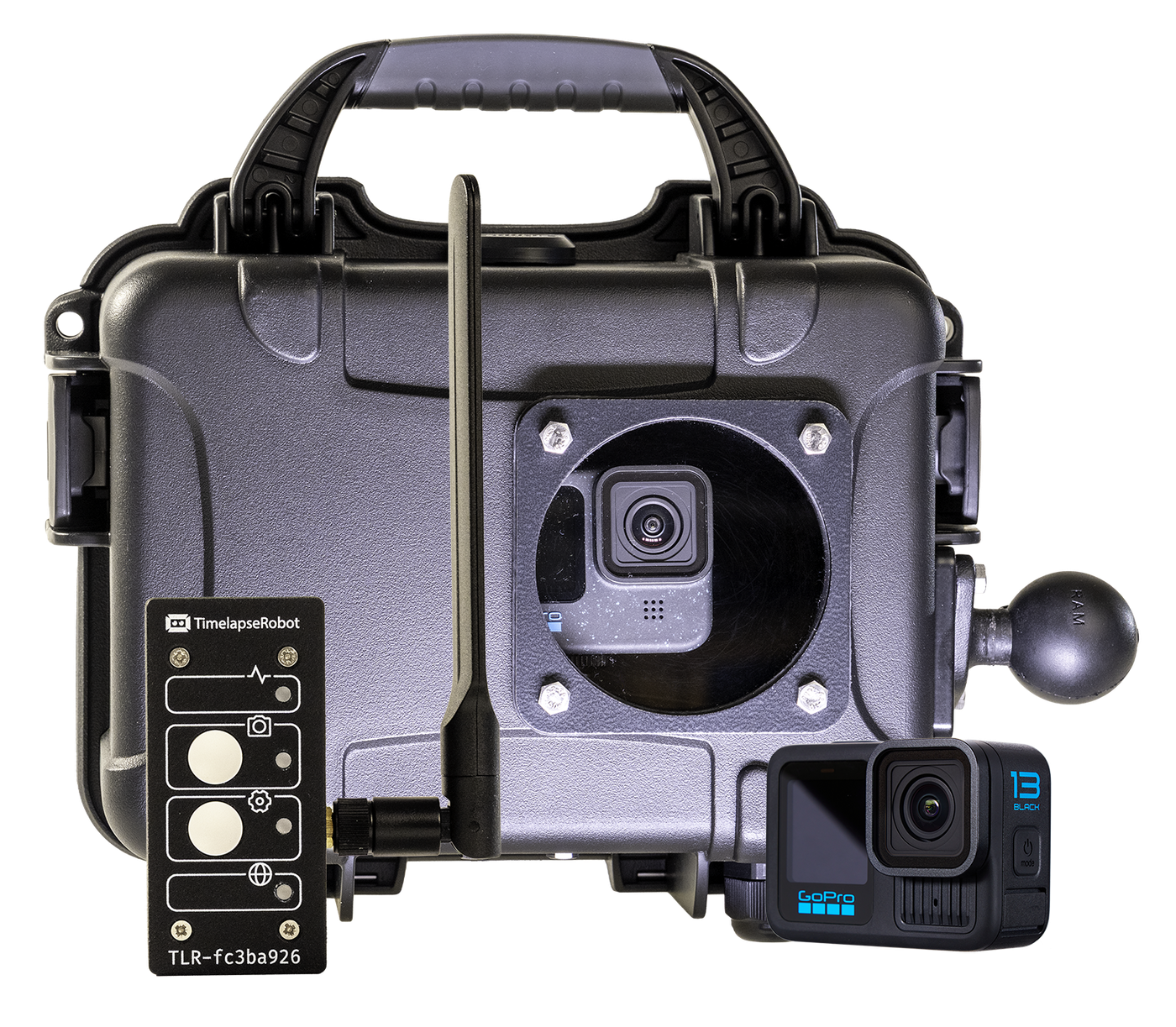
A reliable remote timelapse deployment depends on connected components working together as a system. If you are still deciding which hardware category fits your workflow, see our guide to the best camera for construction timelapse. The camera remains important, but it is only one element in a broader operating model.
Connectivity: mobile network and WiFi
The first requirement is connectivity. A remote system needs a dependable communication path between the camera environment and a central platform. Depending on the project, this may be mobile network infrastructure, fixed internet, or site WiFi. If your workflow is built around an action camera rather than a fixed network camera, see our GoPro construction timelapse long-term setup guide. The right option depends on location, available infrastructure, bandwidth expectations and how the site changes over time.
What matters operationally is not the label of the connection, but whether it supports steady transfer and dependable status visibility. For long-term projects, connectivity should be treated as infrastructure, not as a secondary accessory to the camera.
Cloud storage
Cloud storage plays a central role because it moves the workflow beyond local dependency. When images are transferred off-site regularly, the project gains both accessibility and resilience. Teams can review current material without retrieving memory cards and the documentation is no longer tied entirely to one physical device on one site.
For remote camera monitoring construction environments, this is especially valuable because access may be restricted, site layouts may change and installation points may become harder to reach over time. Centralized storage keeps the documentation available even when the camera itself is operationally distant.
Image ingestion workflows
Cloud transfer alone is not enough. The incoming material needs structure. For a deeper look at camera FTP upload workflows, including timestamp handling, archive structure, and cloud-side processing, read our guide to camera FTP upload for long-term projects.
A good image ingestion workflow organizes files predictably, preserves timing logic and makes activity measurable. For a practical example of scheduled snapshots, remote upload, and cloud-based image organization, read how to turn an IP camera into a construction timelapse system. It should be easy to confirm when the latest image arrived, whether intervals are consistent and whether one project or one camera has gone quiet. In professional environments, incoming files need to be more than archived. They need to be operationally legible.
This is where many weak remote setups fall short. They can send files somewhere, but they do not turn those files into usable monitoring data. A professional workflow does both.
Monitoring dashboards
Once image flow becomes structured, the next step is visibility. Monitoring dashboards provide a central view of deployment activity across one or many projects. Instead of checking cameras individually, teams can review system status from a single operational layer.
A useful dashboard does not need to be visually complicated. It needs to answer practical questions clearly. Which projects are active? When was the last confirmed upload? Which systems are behaving normally? Which ones need attention? Where has recent activity stopped or slowed?
For organizations managing multiple long-term projects, dashboards are one of the clearest differences between isolated camera setups and scalable remote operations.
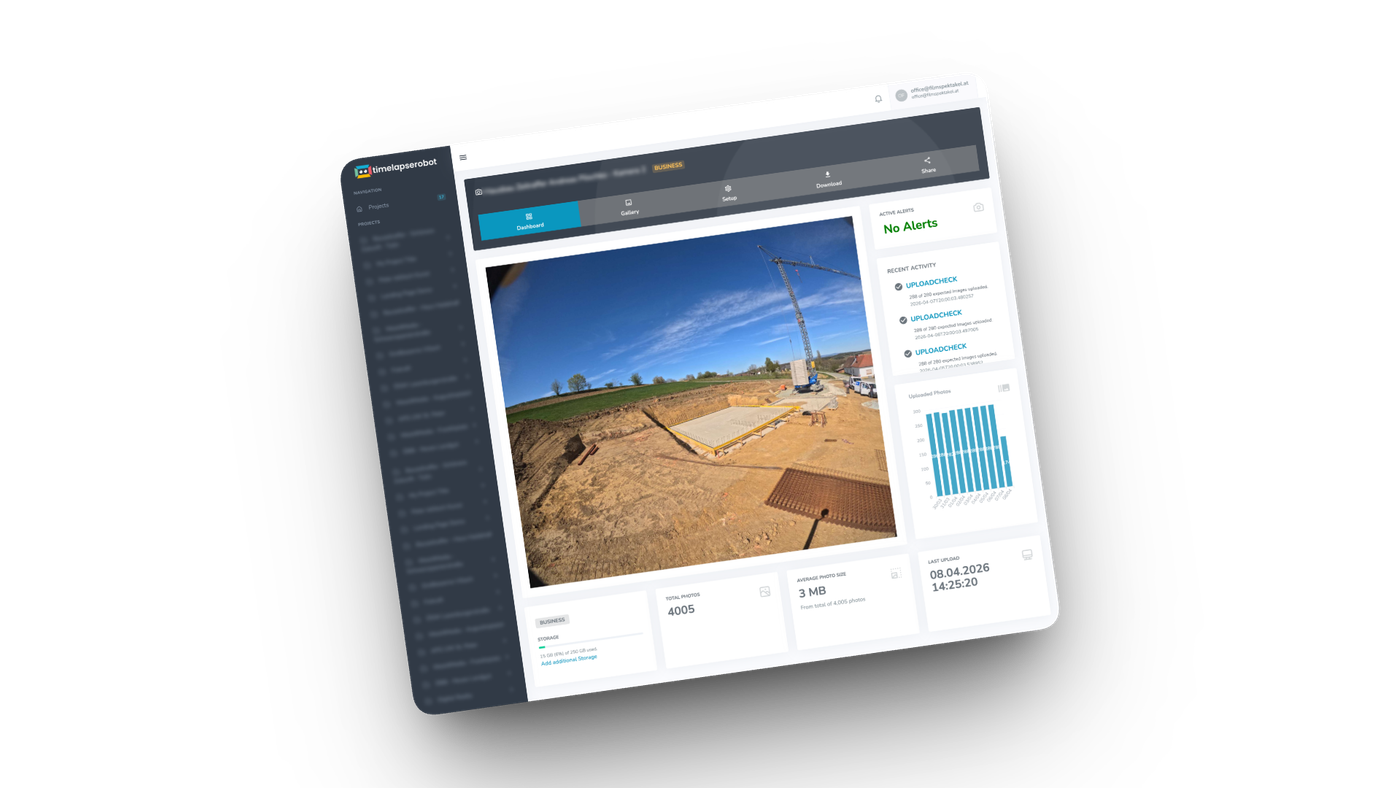
A clean dashboard showing the most important information at a glance.
Real-time monitoring and alerts
Remote access becomes far more valuable when it supports active supervision rather than occasional review.
System health
System health monitoring is the foundation of that supervision. It should provide a reliable picture of whether the deployment is behaving as expected. In a timelapse context, that often means checking for signs such as recent file arrival, expected capture cadence and general continuity of image flow.
This matters because long-term systems do not need to fail dramatically in order to become unreliable. Small interruptions, slowed transfer, missed intervals, or partial workflow breakdowns can all reduce the quality of the final documentation long before anyone considers the system “offline.”
Upload status
Upload status is one of the most useful operational signals in any remote timelapse monitoring workflow. It converts capture into something that can be measured. If the system is supposed to send new material at predictable intervals, then delayed or missing uploads become visible indicators of change.
For professional users, this visibility supports prioritization. Instead of asking whether everything is probably working, teams can identify which deployments are actively producing evidence of continuity and which are not.
Failure notifications
Alerts are what turn visibility into response. A notification system allows operators to act when a camera has not reported activity within an expected window, when uploads stop arriving, or when a project falls outside normal operating patterns.
The purpose of alerts is not to create noise. It is to shorten the distance between issue and awareness. In long-term construction projects, that distance matters greatly. The earlier a deviation is seen, the higher the chance that continuity can be protected.
This matters even more at scale. At Bauzeitraffer.at, we have been filming construction timelapses since 2013, with more than 20 cameras running across different sites at the same time. In theory, checking a camera once a day sounds simple. In practice, checking more than 20 cameras 365 days a year is a completely different task. That experience taught us an important lesson: remote systems should not depend on people manually reviewing routine reports every day. They should check themselves and alert the team only when something is actually wrong. Otherwise, the reports become background noise, people postpone reviewing them, and critical problems are detected too late.
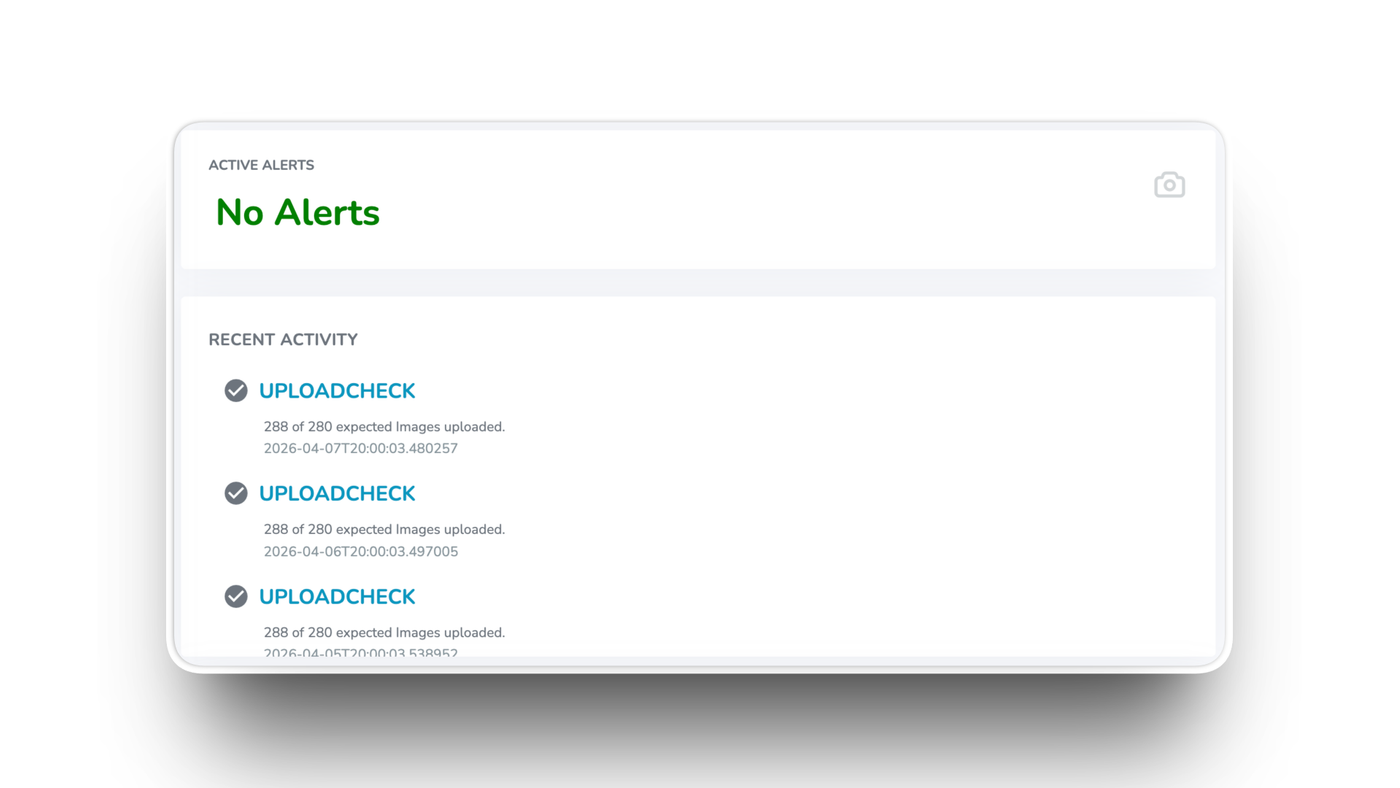
TimelapseRobot dashboard showing camera status and alert-based monitoring for long-term timelapse projects.
Remote access use cases
Remote timelapse systems are useful in several professional scenarios, but their value becomes especially clear in long-duration and multi-stakeholder environments.
Construction projects
Construction projects are a natural fit because they combine long timescales, evolving site conditions, restricted access and a strong need for continuity. Timelapse documentation often supports internal reporting, external communication, project marketing, stakeholder updates, and final case studies. In that context, remote visibility supports both operational reliability and delivery confidence.
Multi-site monitoring
Some organizations do not manage one project at a time. They manage several in parallel. In these situations, the value of construction timelapse monitoring increases significantly because centralized oversight reduces the need for repetitive manual checks across distributed locations.
A remote workflow makes it possible to compare status across projects, identify the few systems that need attention and keep a portfolio of cameras manageable without treating every deployment as an isolated exception.
Agencies managing multiple clients
Media agencies and specialist providers often sit between field operations and client expectations. They may be responsible for maintaining documentation quality across multiple sites, reporting back to different stakeholders and ensuring that visual records remain dependable over long periods.
For these teams, remote infrastructure improves service delivery as much as technical control. Central visibility supports consistency, clearer communication and faster reaction when a project changes or a deployment needs intervention.
Operational benefits
The practical benefits of remote timelapse are easier to understand when viewed as operational improvements rather than purely technical features.
Reduced site visits
A remote system reduces unnecessary travel because teams no longer need to visit simply to confirm whether the deployment is still active. Site visits can be reserved for installation, maintenance, planned adjustments, or issues that genuinely require physical intervention.
That creates efficiency, but more importantly, it creates a better decision model. If you want to understand how remote visibility changes both workload and budgeting, see our guide to construction timelapse costs. Teams act on evidence instead of uncertainty.
Faster problem detection
The value of remote oversight is strongly connected to detection speed. When changes in image flow, status visibility, or upload activity can be seen early, the organization can respond while the issue is still limited in scope.
In long-term documentation, time is rarely neutral. A delay in awareness often becomes a gap in the record. Faster detection therefore improves not only maintenance response, but also the completeness of the project archive.
Improved reliability
Reliability is often misunderstood as a property of hardware alone. In reality, long-term reliability also depends on process. A remotely supervised system benefits from regular status visibility, centralized review and defined response paths. These are process advantages, not just technical ones.
That is why remote operation often produces more dependable outcomes even when the camera hardware itself is unchanged.
Why is remote monitoring essential for multi-month deployments?
As project duration increases, operational complexity increases with it. Not necessarily because the system becomes more sophisticated, but because the environment around it keeps changing.
A deployment that appears stable in its first weeks still has to survive site development, infrastructure changes, weather variation, personnel changes and the normal unpredictability of real-world operations. Over several months or years, even small weaknesses in visibility or process become more significant.
This is why remote camera monitoring construction workflows should not be treated as optional enhancements for high-end projects only. In long-duration environments, remote oversight is part of the basic operating requirement. It allows project teams to supervise systems continuously, maintain confidence in documentation continuity and manage multiple stakeholders with greater clarity.
For B2B users, that operational clarity matters commercially as well as technically. Long-term timelapse is often expected to support reporting, communication, client trust and final delivery quality. A workflow that remains visible and manageable over time is therefore more valuable than one that is merely installed successfully at the beginning.
Summary: from passive recording to actively managed systems
The most important shift in long-term timelapse is the move from isolated capture to supervised operation.
Traditional setups tend to focus on deployment day. For the full process from camera capture to final video rendering, see our guide to construction monitoring camera timelapse. Remote timelapse systems focus on the full lifecycle of the project. They connect the camera to a broader infrastructure of transfer, storage, ingestion, status visibility, dashboards and alerts. That infrastructure makes the documentation process observable. Once it becomes observable, it can be managed properly.
For construction companies, project developers, agencies and photographers working on multi-month or multi-year projects, this is not a minor technical detail. It is the difference between hoping a system is still working and knowing how it is performing.
That is why remote timelapse monitoring should be understood as an operational foundation for long-term visual documentation. It reduces uncertainty, supports continuity, and helps organizations run complex timelapse deployments with greater control. In professional environments, that control is what turns a camera setup into a dependable documentation system.
Frequently asked questions
- What do I need to set up a remote timelapse system?
- Four components working together: a dependable connection between camera and platform (mobile network, fixed internet or site Wi-Fi), automatic cloud storage so images leave the site regularly, an ingestion workflow that organizes files predictably and preserves timing logic, and a monitoring dashboard with health and upload alerts. The camera remains important, but it is only one element in that operating model.
- How do I know my construction camera is still working without visiting the site?
- Through upload status and dashboard visibility. If the system is supposed to send new material at predictable intervals, delayed or missing uploads become visible indicators of change. A useful dashboard answers practical questions clearly: when was the last confirmed upload, which systems are behaving normally, and where has activity stopped or slowed — so site visits are no longer needed just to confirm the system is alive.
- Do I still have to check every camera manually every day?
- No — and at scale it is not realistic anyway. The team behind Bauzeitraffer.at has run more than 20 cameras simultaneously since 2013 and learned that remote systems should not depend on people reviewing routine reports daily. They should check themselves and alert the team only when something is actually wrong; otherwise reports become background noise and critical problems are detected too late.
- How does remote monitoring reduce site visits?
- Teams no longer need to travel simply to confirm whether the deployment is still active. Site visits can be reserved for installation, maintenance, planned adjustments or issues that genuinely require physical intervention. That creates efficiency, but more importantly a better decision model: teams act on evidence instead of uncertainty, and problems are caught while they are still limited in scope.
- Can one dashboard monitor several construction sites at once?
- Yes. For organizations running several projects in parallel, a central dashboard replaces repetitive manual checks across distributed locations. It makes it possible to compare status across projects, identify the few systems that need attention and keep a whole portfolio of cameras manageable. Agencies managing multiple clients also gain consistency, clearer communication and faster reaction when a deployment needs intervention.
- What internet connection does a remote timelapse camera need?
- Depending on the project, mobile network infrastructure, fixed internet or site Wi-Fi can all work. What matters operationally is not the label of the connection but whether it supports steady image transfer and dependable status visibility. For long-term projects, connectivity should be treated as infrastructure in its own right — not as a secondary accessory to the camera.
Planning a long-term construction timelapse?
Discover the system built for multi-month and multi-year construction deployments.
Explore the Construction Timelapse System
