Outdoor Timelapse Camera: A Reliable Long-Term Setup
An outdoor timelapse camera for a long-term construction project has to do far more than capture good images.
Part of the series · Long-Term Construction Timelapse GuideConstruction Timelapse for Long-Term Outdoor Projects: The Professional Guide (Months to Years)
Quick answer
A reliable outdoor timelapse camera setup for long-term construction use needs a proper protective enclosure, systematically sealed cable entries, condensation management, rigid mounting that resists wind and construction vibration, theft-aware positioning and planning for a full seasonal cycle. The design standard is not image quality on day one, but stable, usable images month after month.
An outdoor timelapse camera for a long-term construction project has to do far more than capture good images. It has to continue capturing them through rain, snow, dust, heat, cold, vibration and changing site conditions over many months or even years.
That is the key difference between short-term outdoor photography and a professional outdoor timelapse setup for construction documentation. In a long-term deployment, the challenge is not simply image quality on day one. The challenge is maintaining a stable viewpoint, a protected camera environment and consistent operation over the full life of the project. For the operational layer behind that physical setup, including remote timelapse monitoring, upload visibility, and alerts, read our guide to remote timelapse for long-term construction projects.
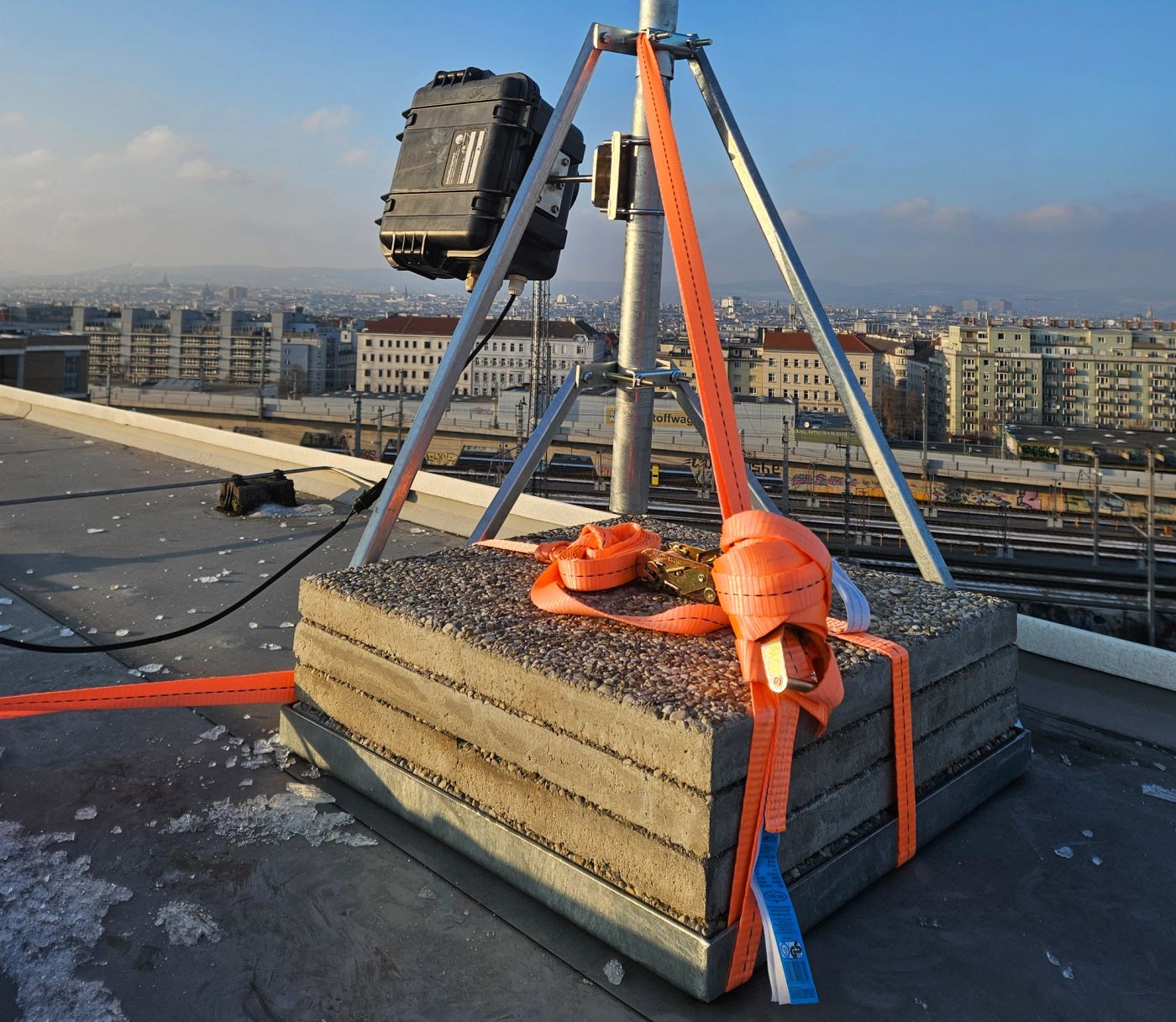
For construction companies, project developers, media agencies, and photographers working on extended outdoor installations, reliability becomes the real design standard. A camera with strong image performance is not enough on its own. If you are specifically comparing GoPro-based and IP camera-based approaches for long-term deployment, see our practical comparison of IP camera vs GoPro timelapse for construction. If you are still deciding between GoPro, IP camera, and DSLR or mirrorless options, read our guide to the best camera for construction timelapse. If you are specifically evaluating a fixed network camera for this kind of deployment, see our guide to best IP camera construction monitoring for long-term timelapse projects. The surrounding enclosure, mounting method, cable routing, environmental protection, and seasonal planning all determine whether the setup will still be working after months of exposure.
This guide focuses specifically on the physical realities of building a weatherproof timelapse camera installation for long-term outdoor use. For a broader system-level view of long-term construction timelapse, including planning, monitoring, operational risk, and full-project reliability, see our guide to construction timelapse for long-term outdoor projects. It is about durable field deployment under real construction conditions.
Why outdoor timelapse setups fail in long-term projects
Most long-term outdoor timelapse problems begin with a simple mistake: the setup is treated like a camera installation instead of an exposed technical system. That is also why budgeting should cover more than the camera itself; our construction timelapse costs guide explains the difference between hardware-only, connected self-managed, and fully managed approaches.
In short-term use, a camera may survive with only basic housing and temporary mounting. Over a long construction timeline, that same approach usually breaks down. Water finds a way through small weaknesses in sealing. Fine dust accumulates on windows and around connectors. Sun exposure causes heat buildup inside the housing. Repeated cooling cycles create condensation. Wind and vibration gradually shift the framing. A mounting point that looked solid at installation begins to move as the site evolves.
This is why a professional construction timelapse setup must be designed for duration, not just for initial deployment. Outdoor environments do not only test equipment once. They apply stress continuously and small weaknesses become significant when they are exposed every day for a year or longer.
Another reason long-term setups fail is that the environment itself changes. A camera position that seems ideal early in the project may later be exposed to more dust, more reflected heat, more mechanical vibration, or easier access for tampering. A successful long-term outdoor timelapse camera installation therefore has to anticipate change rather than assume that the conditions at installation will remain the same.
Core challenges of outdoor environments
A long-term outdoor timelapse setup on a construction project operates in one of the most demanding real-world environments for camera hardware. The core challenges are environmental exposure, temperature instability and site contamination.
Weather exposure: rain, snow, and UV
Rain is the most obvious threat, but it is not the only one that matters. Wind-driven moisture, repeated dampness, and water tracking along cables often create more persistent problems than a single heavy storm. Snow introduces a different type of stress: it can block the lens window, add physical load to exposed parts, and then create meltwater that tests every weak point in the enclosure.
Long-term UV exposure is another factor that is often underestimated. Sunlight gradually degrades plastics, sealants, rubber components, cable jackets, and adhesives. A housing that appears weather resistant on paper may become less reliable after extended solar exposure if the materials are not suited to outdoor use.
For that reason, a weatherproof timelapse camera system should be evaluated not only for immediate rain protection, but also for how well its materials and seals perform after months of sunlight, moisture and thermal cycling.
Temperature changes
Outdoor camera installations are rarely exposed to stable conditions. A housing may become very warm in direct afternoon sun and then cool sharply overnight. In winter, temperatures can remain low for extended periods and place stress on electronics, power systems, and communication devices. For a deeper look at mains power, battery limitations, solar risk, and backup design, read our guide to timelapse camera power supply for long-term construction projects. In transitional seasons, rapid temperature swings are often the trigger for internal moisture problems.
These fluctuations affect more than comfort margins for hardware. They influence the life of seals, the stability of internal air conditions, the behavior of batteries and electronics, and the optical clarity of the viewing window. A professional outdoor timelapse camera must therefore be protected not only against weather itself, but also against the environmental instability that comes with long-term exposure.
Dust and debris on construction sites
Construction sites add a layer of difficulty that many general outdoor camera guides do not fully address. Airborne dust from excavation, concrete work, cutting, drilling, and traffic can settle on housings, lens windows, brackets, cable connections and enclosure seals. This affects both image quality and long-term serviceability.
Dust is especially problematic because it often builds gradually. A camera may still operate, but the image can slowly soften or appear hazy as the front window becomes contaminated. During maintenance, dust can also enter the housing if openings are made in dirty conditions.
A reliable construction timelapse setup should therefore be planned with dust exposure in mind from the beginning. On real sites, contamination is not an occasional inconvenience. It is part of the normal operating environment.
Weatherproofing an Outdoor Timelapse Camera
Weatherproofing is the foundation of any long-term outdoor deployment. Without it, the most capable camera body still becomes vulnerable.
Enclosures and housing
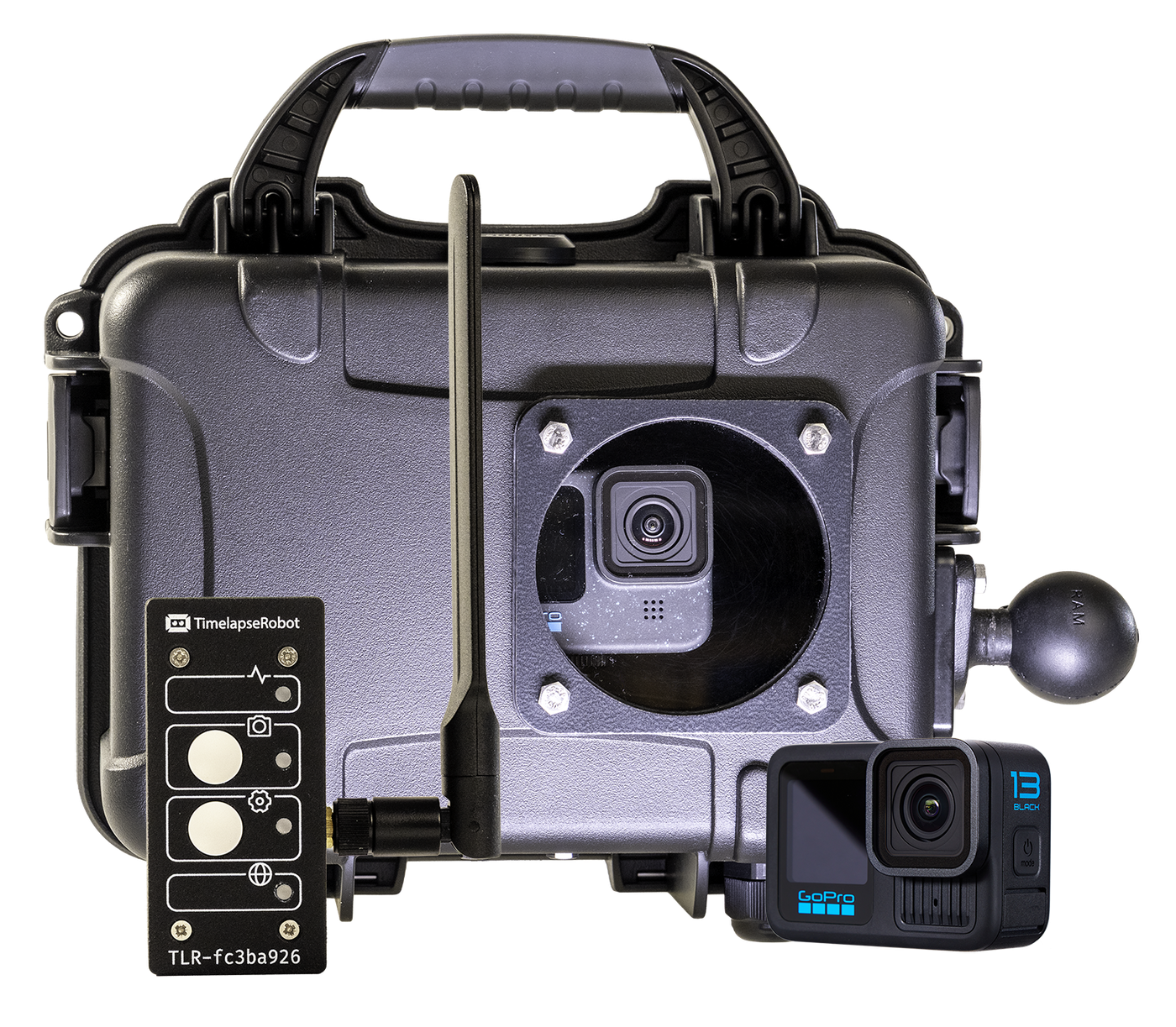
A dedicated housing is usually the central element of a professional outdoor timelapse setup. Even when a camera is marketed as weather resistant, long-term deployment often benefits from an external enclosure that adds physical protection, shields against debris, and gives greater control over the internal environment. If your deployment is based on a GoPro, see our GoPro construction timelapse guide for a more detailed look at long-term protection, monitoring, and setup design.
A well-designed enclosure should protect the camera from direct rain, wind-driven moisture, dust, and UV stress while still allowing a clear, undistorted view of the site. The front window must remain optically usable over time, which means material quality matters. If the front surface scratches easily, fogs, reflects excessively, or becomes difficult to clean, the housing may protect the camera while still degrading the final output.
Ease of maintenance also matters. An enclosure that is theoretically robust but difficult to inspect or reseal can become a liability during long-term operation. On construction projects, service visits often happen under imperfect field conditions. The housing should make correct handling easier, not harder.
Sealing and cable protection
One of the most common weak points in a weatherproof timelapse camera installation is the cable path. Water rarely enters only through large openings. More often, it follows gravity and finds its way through poorly sealed cable glands, exposed connectors, or poorly planned routing.
For that reason, sealing should be approached as a system, not as a final layer of patching. Cable entry points should use proper fittings. Cables should be routed so that water naturally falls away from sensitive areas rather than toward them. Strain relief is also important, because repeated movement or tension can compromise seals over time.
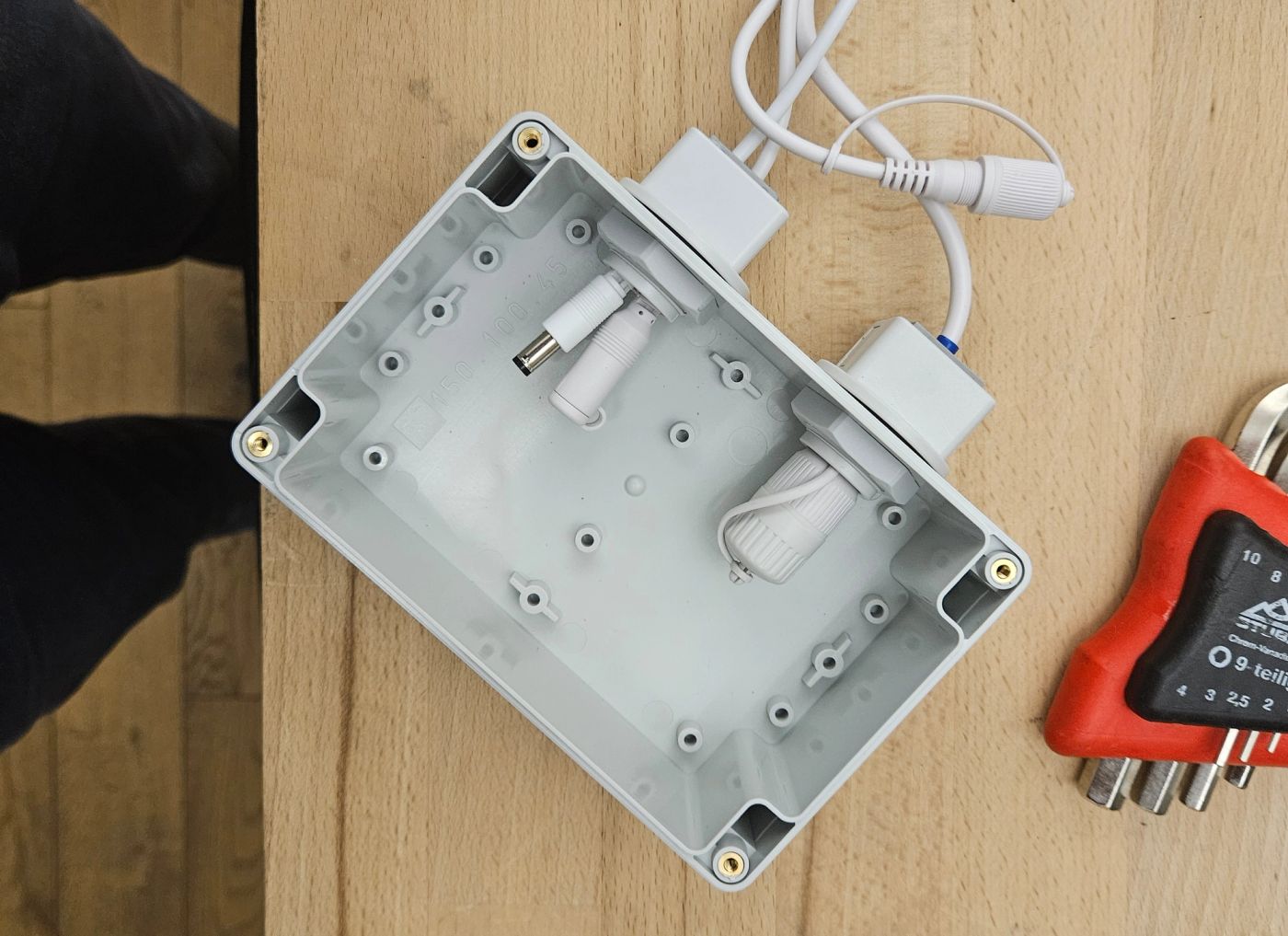
External cable protection is equally important on construction sites. Cables should not be left where they can rub against edges, fill with dirt, or be pulled accidentally. Conduit, protective sleeving, secure fastening and deliberate path planning all help turn a vulnerable installation into a durable outdoor timelapse camera system.
Preventing condensation inside the enclosure
Condensation is one of the most frustrating issues in long-term outdoor camera work because it can happen even when the enclosure appears properly sealed.
Causes
Condensation forms when moisture inside the housing meets a cooler internal surface. This often happens after the enclosure warms during the day and cools rapidly at night, or when changing weather creates sudden temperature drops. If humid air was trapped inside the housing during installation or maintenance, that moisture may condense repeatedly as temperatures cycle.
The result is often a fogged front window, moisture on internal surfaces, or gradual corrosion risk around connectors and electronics. In many cases, the camera itself still works, but the images become compromised long before the underlying cause is addressed.
Because of this, condensation should be treated as a likely design scenario in any long-term outdoor timelapse setup, not as a rare exception.
Ventilation vs sealing trade-offs
There is no universal rule that says an enclosure should always be fully sealed or always be ventilated. Both strategies involve compromise.
A tightly sealed housing can keep out water and dust very effectively, but it may also trap humid air inside. A more ventilated design can reduce heat buildup and help manage internal moisture, but it may expose the system to fine dust or external humidity if handled poorly.
The right choice depends on climate, solar exposure, site contamination levels, and housing design. In practice, the best results often come from controlled management of the enclosure environment rather than from pushing to the extreme of total sealing alone. The goal is not simply to close the housing as tightly as possible. The goal is to maintain a stable, dry internal environment over time.
Real-world scenarios
Condensation often appears in predictable field situations. A housing is closed on a humid day and looks fine at installation, then fogs after the first cold night. A camera mounted in direct sun heats strongly all afternoon, only to cool quickly after sunset. A site near wet concrete, heavy rainfall, coastal air, or persistent morning moisture creates a humid microclimate around the enclosure.
On construction projects, condensation can be especially easy to miss because the effect is not always dramatic. The front window may not appear visibly wet. Instead, it may develop a soft haze that reduces clarity across weeks of captured images. That makes early inspection critical in any professional weatherproof timelapse camera deployment.
Mounting stability
A camera that stays dry but does not stay still is not a reliable timelapse system. Mounting quality is just as important as enclosure quality.
Wind
Wind exposure creates repeated stress on the entire installation. Even moderate movement can become visible in a timelapse sequence when it occurs frame after frame over months.
Large housings, long brackets and unsupported mounts can all amplify this effect.
The mounting structure should therefore be selected for long-term rigidity, not just apparent stability during installation. It is important to reduce flex, minimize leverage, and avoid mounting positions that act like vibration arms in open wind conditions. For a professional outdoor timelapse setup, the mounting point must remain stable under changing weather, not simply feel solid by hand for a few minutes.
Vibration from construction activity
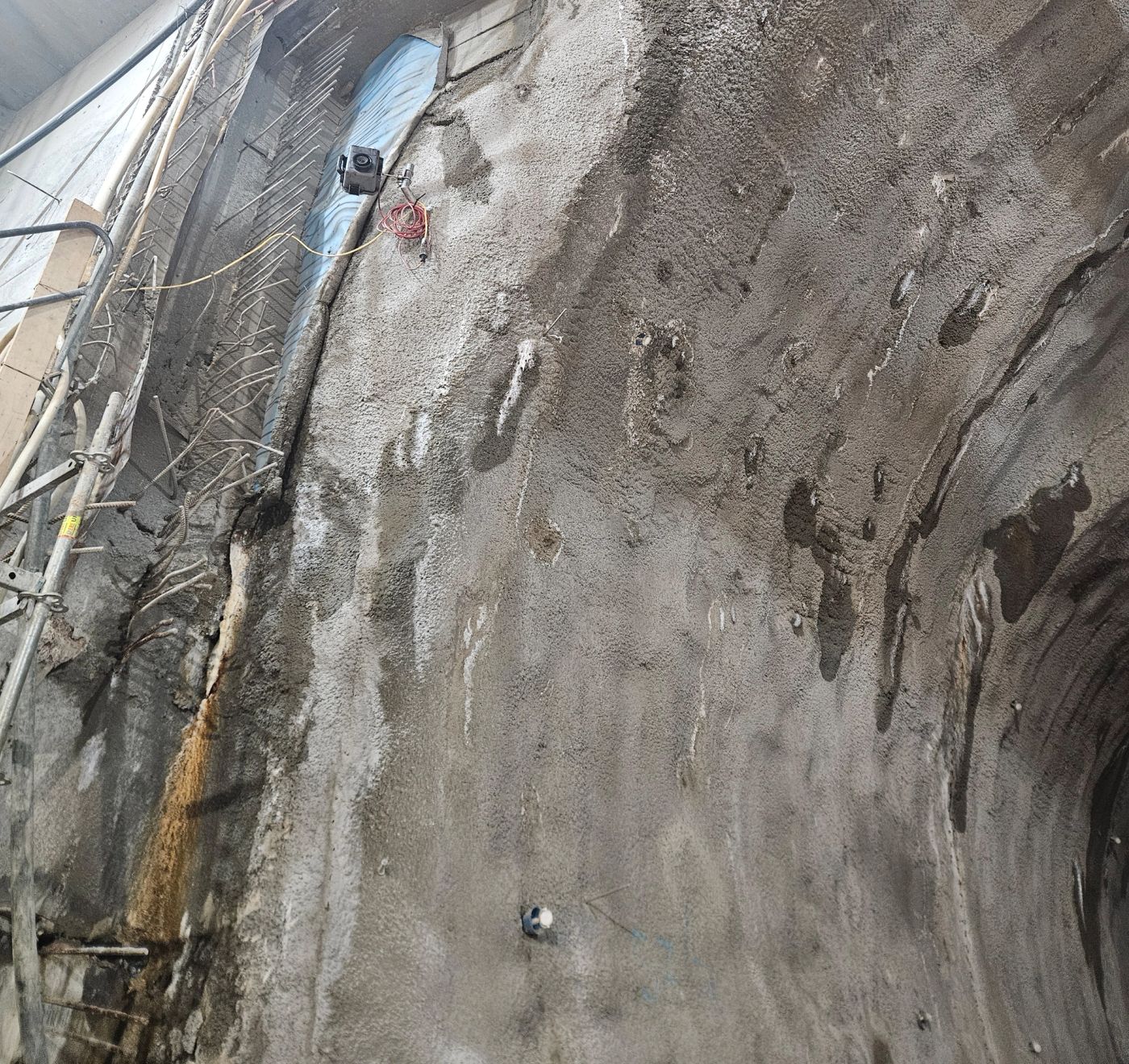
Construction environments introduce a second challenge that ordinary outdoor photography may not face to the same degree: continuous mechanical vibration. Heavy vehicles, drilling, demolition, compacting and structural works can all transmit movement into camera mounts.
This is why the choice of mounting surface matters so much in a construction timelapse setup. Two visually similar positions may behave very differently once the site becomes active. A mount fixed to an apparently convenient structure may experience ongoing vibration that gradually affects alignment or image sharpness.
Long-term alignment drift
Alignment drift is usually slow rather than dramatic. A bracket settles slightly. A fastener relaxes. A support point moves as thermal expansion and contraction accumulate. After several months, the framing is no longer consistent with the beginning of the project.
For long-term timelapse, this matters because consistency is part of the value of the final result. A strong outdoor timelapse camera installation should therefore include not only rigid mounting, but also the ability to verify framing and correct small changes before they become major ones.
Security and theft prevention on construction sites
Security is a practical part of physical setup design. On an active construction site, a camera installation may be visible to workers, subcontractors, visitors and passersby over a long period of time. That makes theft, tampering, and accidental contact real risks.
A secure outdoor timelapse setup starts with positioning. Systems that are easy to reach, easy to disconnect, or obviously exposed are more vulnerable. Cable routing also plays a role. Visible, accessible cables often make a setup easier to interfere with.
Security planning should also consider how the site changes. New scaffolding, temporary structures, and shifting access routes can make a previously protected camera suddenly reachable. Long-term outdoor deployment therefore benefits from periodic review of physical security, not only a one-time installation decision.
Seasonal challenges
A multi-month or multi-year installation must survive more than one type of weather. It must remain reliable through a full seasonal cycle.
Winter: cold, snow, and low light
Cold weather affects hardware operation, startup behavior and in some systems the reliability of supporting electronics. Snow can accumulate on enclosures, obstruct the viewing window, and introduce freeze-thaw stress around seals. Lower winter light also makes optical contamination more noticeable.
A professional weatherproof timelapse camera setup should be planned for winter before winter arrives. The housing, viewing angle, accessibility for cleaning, and exposure to snow buildup all need to be considered in advance.
Summer: heat and direct sunlight
Summer creates the opposite kind of stress. Direct sun can raise internal housing temperatures far beyond ambient air temperature, especially when enclosures are dark, sealed tightly, or mounted against surfaces that reflect heat. This can affect electronics, shorten component life, and worsen internal moisture problems.
In long-term outdoor timelapse camera installations, summer reliability depends on reducing heat buildup as carefully as winter reliability depends on handling cold and moisture.
Common outdoor setup mistakes
Many outdoor timelapse problems come from treating weather protection too lightly. Typical mistakes include using housings that are only marginally suitable, underestimating cable entry points as failure risks, mounting to structures that are not truly stable, ignoring dust exposure, and assuming that a sealed enclosure automatically solves condensation.
Another common mistake is designing only for present conditions. Outdoor construction sites change, and a good installation must be able to cope with that change. What is safe, stable, and clean in the first month may not remain so later.
Best practices for reliable long-term outdoor timelapse
A reliable outdoor timelapse setup is built around durability, environmental control and physical stability. The camera matters, but it should be seen as one component inside a larger field system. For the broader workflow beyond physical outdoor setup, see our guide to construction monitoring camera timelapse. If you prefer a fixed-position network camera workflow, read our guide on how to turn an IP camera into a construction timelapse system. For a more detailed look at the upload layer behind that kind of setup, including FTP workflows, timestamp handling, archive structure, and cloud-side processing, read our guide to camera FTP upload for long-term projects.
Use a proper enclosure rather than relying on minimal weather resistance alone. Treat cable routing and sealing as critical engineering details. Plan specifically for condensation, not just rain. Mount the system to a structure that will remain stable through wind, vibration, and time. Reassess the installation as the site evolves. Prepare for both winter and summer rather than assuming one design will behave equally well in all conditions.
Above all, remember that long-term construction timelapse is not defined by whether the setup works on installation day. It is defined by whether the weatherproof timelapse camera continues to capture clean, stable, usable images month after month under real outdoor conditions. That is what separates a temporary camera placement from a professional long-term deployment.
Frequently asked questions
- Why do outdoor timelapse cameras fail on long construction projects?
- Most failures start with treating the setup as a simple camera installation instead of an exposed technical system. Over months, water finds small sealing weaknesses, dust settles on windows and connectors, sun causes heat buildup, cooling cycles create condensation, and wind and vibration gradually shift the framing. The site itself also changes, so a position that was ideal at installation can later become exposed or accessible.
- Do I need an extra enclosure if my camera is already weather resistant?
- Usually yes for long-term deployment. An external enclosure adds physical protection, shields against debris and gives more control over the internal environment. Marketed weather resistance is often not designed for months of continuous UV, moisture and thermal cycling. The front window quality matters too: if it scratches, fogs or reflects easily, the housing can protect the camera while still degrading the images.
- How do I prevent condensation inside a timelapse camera housing?
- Condensation forms when humid air trapped inside the housing meets a cooler surface, typically after daytime heating and rapid overnight cooling. There is no universal rule favoring full sealing or ventilation; both involve trade-offs depending on climate, sun exposure and site dust. The goal is a stable, dry internal environment over time, plus early inspection, because a soft haze on the window can degrade weeks of images unnoticed.
- How should a timelapse camera be mounted on an active construction site?
- Choose a structure with long-term rigidity, not just apparent stability at installation. Reduce flex and leverage, avoid mounts that act like vibration arms in wind, and consider that heavy vehicles, drilling and demolition transmit continuous vibration into mounts. Alignment drifts slowly as fasteners relax and thermal cycles accumulate, so the setup should allow periodic framing checks and small corrections before drift becomes a major problem.
- How do winter and summer each affect an outdoor timelapse setup?
- Winter brings cold that stresses electronics and startup behavior, snow that can block the viewing window and add load, and freeze-thaw stress on seals, while low light makes lens contamination more visible. Summer creates the opposite stress: direct sun can push internal housing temperatures far above ambient, affecting electronics, shortening component life and worsening moisture problems. A long-term installation must be planned for the full seasonal cycle in advance.
- How do I protect a construction timelapse camera against theft and tampering?
- Start with positioning: systems that are easy to reach, easy to disconnect or obviously exposed are more vulnerable, so mounting out of reach helps. Cable routing matters as well, since visible, accessible cables make interference easier. Security should also be reviewed periodically, because new scaffolding, temporary structures and shifting access routes can suddenly make a previously protected camera reachable as the site evolves.
Planning a long-term construction timelapse?
Discover the system built for multi-month and multi-year construction deployments.
Explore the Construction Timelapse System

